
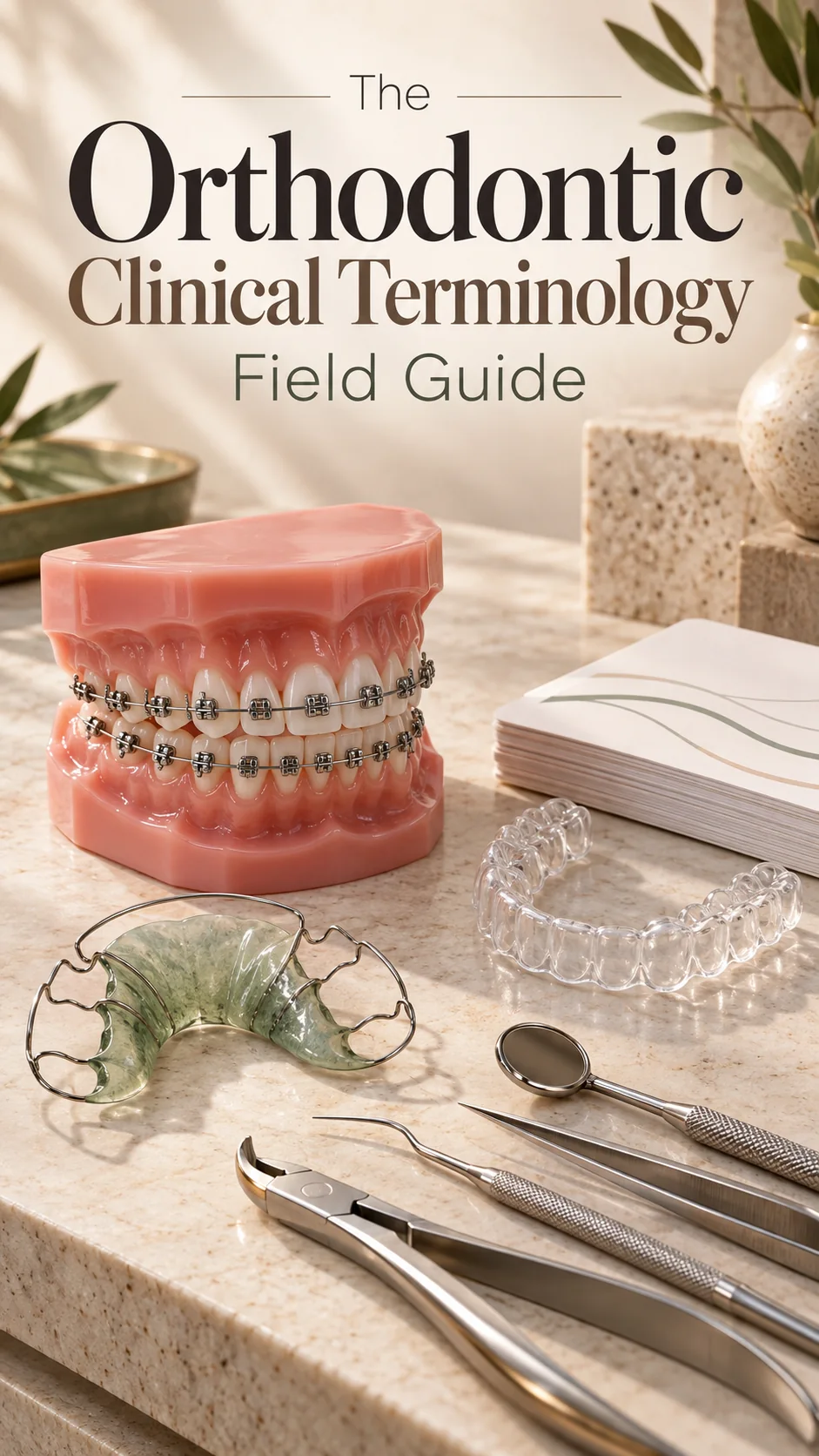
The Orthodontic Clinical Terminology Field Guide
Orthodontic Clinical Care • Resource-First Edition
October 25, 2026
A new orthodontic team member can hear ten unfamiliar terms before the first patient is seated: archwire, attachment, debond, ligature, retainer, scan, occlusion, sterilization, handoff, and more. Learning the vocabulary matters because clear language helps the team prepare the right materials, document the patient’s question accurately, and route concerns without guessing. It also makes orientation less intimidating for candidates who bring strong people skills but are still building clinical familiarity.
Today’s saveable resource is a one-page Orthodontic Clinical Terminology Field Guide. It is not a treatment manual or a substitute for hands-on training. Instead, it gives beginners a shared vocabulary for listening, charting, preparing, and asking better questions while staying within the duties allowed by state law, credentials, supervision, and office policy.
Why Shared Vocabulary Improves Patient Care
Orthodontic treatment is a long journey with repeated appointments, changing appliances, and many small handoffs. When a patient says “the wire is poking,” a support team member should record the patient’s words, identify the correct category of appliance, and promptly route the concern according to office protocol. The team member should not diagnose the cause, change the appliance, or promise a clinical solution unless that action is specifically authorized and within scope.
Precise vocabulary also prevents avoidable mix-ups. A clear aligner is not the same as a removable retainer, even though both may look like transparent trays. A bracket is the attachment bonded to a tooth in a braces system, while the archwire passes through bracket slots. The American Association of Orthodontists maintains a public glossary that defines these terms and explains common appliances in patient-friendly language.
From Memorizing Words to Understanding Workflow
The best way to learn terminology is to connect each term to a moment in the patient journey. “Scan” may appear during records or appliance planning. “Adjustment” or “activation” may describe an appointment in which the licensed treating team evaluates progress and carries out the prescribed clinical plan. “Debond” refers to removal of fixed orthodontic attachments at the end of that phase of treatment, followed by the retention stage directed by the orthodontist.
Beginners should practice three layers of understanding. First, recognize the word. Second, know what object or workflow stage it describes. Third, know what the word does not authorize you to do. Recognizing “archwire” does not mean a new employee may cut, replace, or adjust one independently. Knowing “occlusion” means the way the teeth meet does not authorize a support staff member to diagnose a bite condition.
A Language Tool for Better Handoffs
Consider an illustrative scenario: a parent calls and says a “brace came off.” A useful response begins with neutral clarification: Is the small attachment loose from the tooth, is a wire displaced, or is another appliance involved? The support person documents the description without converting it into a diagnosis, checks for any concern that requires prompt clinical attention, and routes the message to the treating orthodontist or authorized clinical professional.
The same discipline matters chairside. A patient may use everyday language such as “rubber band,” while the chart or treatment plan uses a more specific term. The field guide helps a beginner recognize possible meanings, but the clinician of record determines the instruction. This keeps communication accurate and protects the patient from well-intended improvisation.
Cleanliness Terms Belong in the Vocabulary Too
Orthodontic language is not limited to teeth and appliances. New hires must understand the difference between cleaning, disinfection, and sterilization within the practice’s written infection-prevention program. The CDC identifies Standard Precautions as the foundation for safe dental care and includes hand hygiene, appropriate personal protective equipment, sharps safety, sterile instruments and devices, and cleaned or disinfected environmental surfaces.
A terminology card cannot teach instrument processing by itself. Practices need role-specific training, manufacturer instructions, written protocols, and competency checks. The card simply helps a beginner hear the correct word and recognize that each process has a defined purpose. When the word is unfamiliar or the next step is uncertain, the safe action is to stop and ask the designated trainer or infection-prevention coordinator.
Scope, Credentials, and the Meaning of “Clinician”
In this series, “Orthodontic Clinician” is an editorial label for learning about orthodontic clinical care; it is not a single nationally standardized credential. Orthodontists and other licensed treating professionals make clinical diagnoses and treatment decisions. Dental assistants, orthodontic clinical support staff, technicians, treatment coordinators, and front-office staff work within state-specific duties, required credentials, supervision, training, and employer policy.
DANB directs dental assistants to review their state’s job levels and allowable duties. Ohio’s State Dental Board separately publishes requirements and permissible-practice information for dental auxiliaries and expanded-function roles. A job title alone never establishes authority. A careful applicant asks what credential is required, who provides supervision, what competency training is documented, and which duties belong to the licensed treating professional.
How to Use This Field Guide
Keep the page in a new-hire binder, beside the phone script, or at a team learning station. Review five terms at a time, then connect each term to an actual room setup, appointment type, chart entry, or escalation pathway. During shadowing, write down unfamiliar language and verify it with the practice’s approved sources instead of relying on memory.
For interview preparation, the goal is not to sound like an orthodontist. A stronger answer is: “I’m learning the terminology so I can communicate clearly, prepare accurately, and know when to ask the treating clinician.” That statement shows coachability, respect for scope, and attention to patient safety.
Practical Takeaway
Vocabulary becomes valuable when it improves action. Learn the word, connect it to the workflow, document what the patient actually reported, and escalate anything clinical or unclear. The best beginner is not the person who pretends to know every term; it is the person who communicates precisely, protects the patient, and keeps learning.
PRACTICAL RESOURCE
The Orthodontic Clinical Terminology Field Guide
Beginner reference • Confirm local usage, scope, and workflow with the treating orthodontist and practice trainer
APPLIANCES AND COMPONENTS
Braces — A fixed orthodontic system commonly made of brackets, bands, and wires.
Bracket — A small attachment bonded to a tooth; its slot holds the orthodontic wire.
Archwire — The wire that passes through bracket slots as part of the prescribed braces system.
Band — A metal ring fitted around a tooth and used as part of some orthodontic appliances.
Ligature or tie — Material used to help hold an archwire in a bracket; designs vary.
Elastic — A small rubber band used only as directed within the orthodontist’s treatment plan.
Clear aligner — A custom removable tray used in a prescribed sequence to move teeth.
Attachment — A tooth-colored shape bonded to a tooth to help an aligner deliver prescribed movement.
Retainer — A removable or fixed appliance used after active treatment to help maintain results.
Appliance — A broad term for an orthodontic device; ask for the specific type when documenting.
APPOINTMENTS AND RECORDS
Records — The approved photos, scans, radiographs, forms, and clinical information used for care.
Scan or impression — A digital or physical method of recording tooth and oral structures for authorized clinical use.
Adjustment or activation — An appointment involving evaluation and prescribed changes by authorized clinical personnel.
Debond — Removal of fixed orthodontic attachments at the end of that treatment phase.
Retention — The stage focused on maintaining treatment results with the orthodontist’s prescribed plan.
Occlusion or bite — How the upper and lower teeth meet; interpretation belongs to the treating professional.
Handoff — A structured transfer of accurate patient information, questions, and next steps between team members.
Escalation — Promptly routing a question, symptom, or appliance issue to the treating orthodontist or authorized clinician.
SAFETY AND TEAM LANGUAGE
Standard Precautions — CDC-recommended infection-prevention practices used for all patients.
Cleaning — Removal of visible soil and debris as part of the approved reprocessing workflow.
Disinfection — Use of an approved process for surfaces or items as directed by policy and manufacturer instructions.
Sterilization — A validated process used for appropriate reusable instruments according to protocol.
PPE — Personal protective equipment selected for the task under the practice’s infection-prevention procedures.
Scope of practice — Duties legally permitted for a role under state requirements, credentials, and supervision.
Clinical decision — Diagnosis, treatment selection, prescribed changes, or individualized advice reserved for authorized licensed professionals.
USE THE WORD SAFELY
□ Repeat the patient’s description before translating it into a chart term.
□ Confirm the appliance or appointment type in the record.
□ Do not turn vocabulary recognition into diagnosis or independent treatment advice.
□ Document the question and route it to the correct person.
□ When terminology, authority, or next steps are unclear, stop and ask.
A Useful Next Step
If this field guide helps your team identify gaps in onboarding or interview preparation, browse the Made for This guides and resources at https://madeforthisblog.web.app/shop.html. Use any resource as a planning aid, then adapt training materials to the practice’s policies, state requirements, and licensed clinical leadership.
SOURCES
American Association of Orthodontists — Glossary of Orthodontic Terms; accessed October 25, 2026. https://aaoinfo.org/resources/glossary-of-orthodontic-terms/
American Association of Orthodontists — Orthodontic Treatment Methods; accessed October 25, 2026. https://aaoinfo.org/treatments/
American Association of Orthodontists — Orthodontic Retainers; accessed October 25, 2026. https://aaoinfo.org/treatments/retainers/
Centers for Disease Control and Prevention — Standard Precautions; updated May 15, 2024. https://www.cdc.gov/dental-infection-control/hcp/summary/standard-precautions.html
Centers for Disease Control and Prevention — Sterilization and Disinfection; accessed October 25, 2026. https://www.cdc.gov/dental-infection-control/hcp/summary/sterilization-disinfection.html
Dental Assisting National Board — State Dental Assisting Requirements; accessed October 25, 2026. https://www.danb.org/state-requirements
Ohio State Dental Board — Expanded Function Dental Auxiliary and Permissible Practices; accessed October 25, 2026. https://dental.ohio.gov/licensing-and-renewal/005-expanded-function-dental-auxiliary
PLANNED ORTHODONTIC CLINICAL CARE GUIDEBOOK ROADMAP
Planned Part 1 — Starting the Orthodontic Patient Journey
Planned Part 2 — Braces, Aligners, Retainers, and Appliance Care
Planned Part 3 — Communication, Comfort Questions, and Escalation
Planned Part 4 — Room Readiness, Infection Prevention, and Handoffs
Planned Part 5 — Privacy, Consent, and Professional Documentation
Planned Part 6 — Training Pathways, Terminology, Interview Readiness, and Team Growth
These parts are planned editorial directions only; no guidebook publication is claimed here.