
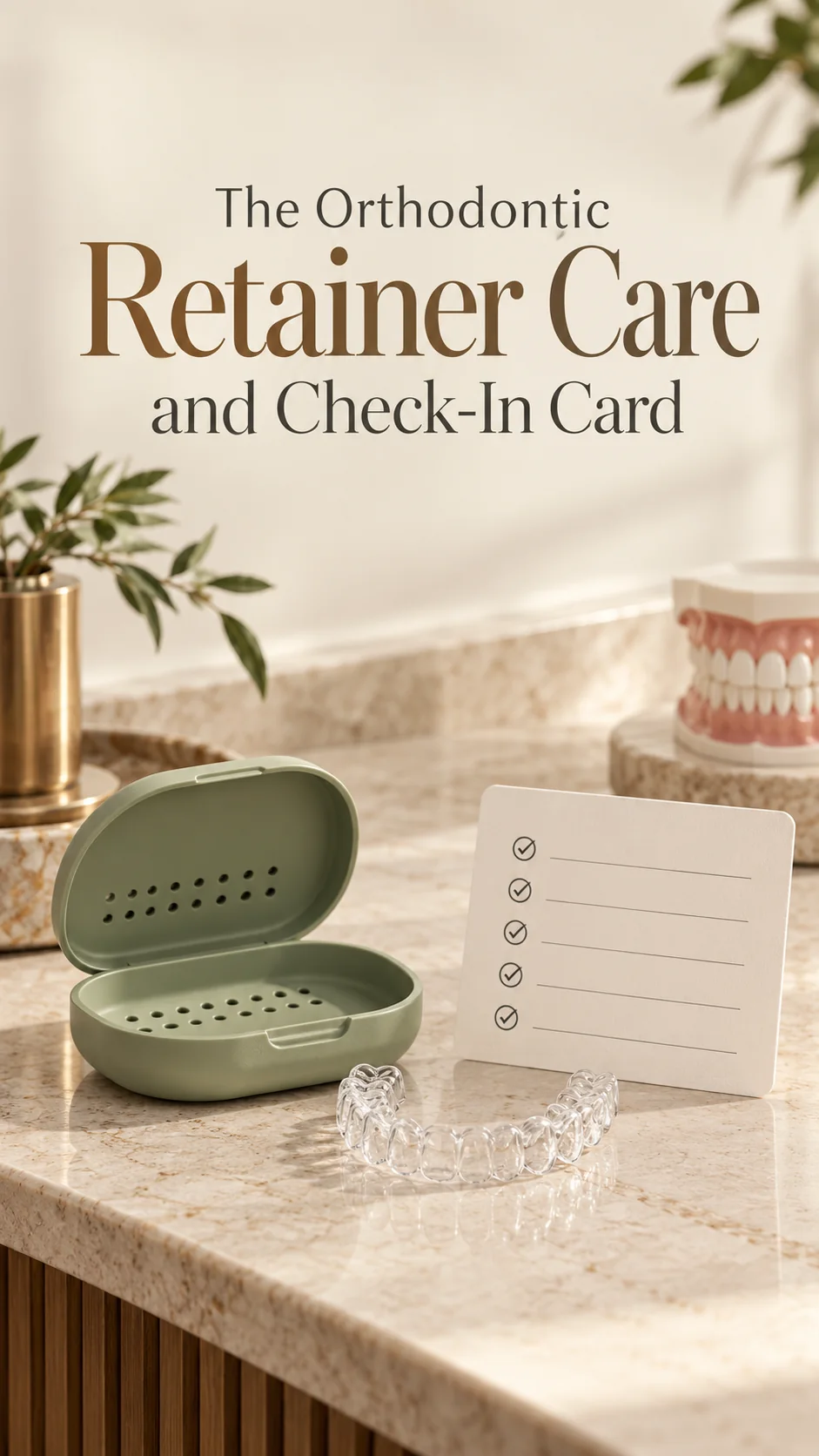
The Orthodontic Retainer Care and Check-In Card
A patient-friendly tool for daily care, fit awareness, appointment preparation, and timely contact with the treating orthodontist
Made for This • Orthodontic Clinical Care • October 28, 2026
The day braces come off or aligner treatment ends can feel like a finish line, but retention is an active part of the orthodontic journey. A retainer is designed to help hold teeth in their finished positions after active treatment. The American Association of Orthodontists emphasizes that retainers may be removable or fixed and that wear instructions are individualized. A simple care and check-in card helps patients and families keep those instructions visible without turning a general handout into a substitute for the treating orthodontist’s plan.
A Retainer Is a Treatment Phase
Retention asks patients to manage a device when they are no longer visiting the office as frequently as they did during active treatment. That change can create small gaps in routine: the case stays at home, a removable retainer is wrapped in a napkin during lunch, or a change in fit is noticed but not written down. The card in this package is designed to close those gaps by placing the most useful habits and questions in one screenshot-friendly page.
The resource is deliberately not a universal wear schedule. The AAO explains that the amount of daily wear depends on the orthodontist’s recommendation and the patient’s stage after treatment. One patient may be told to wear a removable retainer on a particular schedule, while another may have a fixed retainer that requires different cleaning and monitoring. The card therefore includes blank fields for the treating orthodontist’s actual instructions rather than guessing.
Why a Small Card Works
Long instructions are easy to lose, especially when several family members help manage appointments. A concise card can stay on a refrigerator, inside a school binder, or in a phone’s favorites folder. It gives the patient a consistent place to record when the retainer began feeling different, whether a crack or rough edge appeared, and what questions should be raised at the next check-in.
The card also supports better conversations. “It feels weird” is a valid starting point, but an orthodontic team can respond more efficiently when the patient can add useful context: when the change began, whether the device is removable or fixed, whether it still seats fully, and whether there is visible damage. Recording observations does not mean diagnosing the cause. It simply helps the treating professional understand what the patient is experiencing.
Care Is Specific, Not Universal
General care principles are useful, but the orthodontist’s instructions come first. AAO guidance recommends keeping a removable retainer in its protective case when it is not being worn, avoiding hot water and harsh chemicals that may damage the material, and contacting the orthodontist when the retainer is lost, damaged, distorted, or no longer fits as expected. For fixed retainers, patients should follow the cleaning method demonstrated by their treating team and report a loose or broken wire.
Conflicting advice online is one reason the card avoids naming a single household cleaner. Retainer materials differ, and office instructions may vary. The safest educational language is to use the cleaning method approved for that specific appliance, rinse with the temperature directed by the orthodontic team, and never use heat to reshape it. A patient should not trim, glue, bend, or force a retainer in an attempt to repair it.
What Deserves a Prompt Call
A lost, cracked, warped, sharp, painful, or poorly fitting retainer should not simply wait until the next routine visit. The AAO advises contacting the orthodontist promptly about a lost or damaged retainer because teeth can move and the appliance may need to be evaluated or replaced. A patient should also contact the office when a fixed retainer wire feels loose, an edge irritates the mouth, or the bite or fit seems to have changed.
Some situations move beyond an ordinary orthodontic call. The AAO’s orthodontic-emergency guidance identifies trouble breathing or swallowing, heavy or uncontrolled bleeding, suspected jaw fracture, major facial trauma, and a permanent tooth that is knocked out or severely displaced as reasons to seek urgent medical or dental help. The card separates these red-flag situations from routine check-in notes so families do not rely on a worksheet when immediate care may be needed.
The Clinical Support Team’s Role
Orthodontic clinical support staff can help a patient organize concerns, confirm the office’s approved instructions, document the patient’s words, and route questions to the treating orthodontist. They do not independently decide that a retainer is safe to keep wearing, alter an appliance, diagnose tooth movement, prescribe care, or treat pain. Duties, credentials, and supervision requirements for assistants and technicians vary by state; DANB’s state-requirements tool is a starting point for checking the applicable job levels and allowable duties.
That boundary improves patient trust. A clear response might be: “I’m going to document when this started and ask the orthodontist to review the fit.” The support team can then follow the office’s escalation policy. This keeps the patient from receiving an improvised answer and gives the licensed treating professional the information needed for an individualized decision.
How to Use the Check-In Card
At delivery, the treating team or authorized staff member can fill in the type of retainer, the prescribed wear schedule, the approved cleaning method, and the office contact route. The patient keeps the card where the retainer routine happens. Before an appointment—or whenever something changes—the patient completes the fit and condition prompts and brings the retainer and its case if the office requests them.
For families, the card can reduce the familiar “I thought someone else called” problem. One adult can record the concern and the date the office was contacted, while the patient notes what changed. The card is not meant to monitor or shame; it is a shared memory aid.
An Illustrative Example
Imagine a teenager notices that a removable retainer no longer seats fully on one side after being left in a hot car. The family does not force it, heat it again, or attempt a repair. They mark “fit changed,” record when it happened, place the retainer safely in its case, and contact the treating orthodontist for instructions. The orthodontic team can then decide whether the patient should be seen and what to do next.
Career Relevance for Beginners
New team members often learn technical terms before they learn how to guide a calm, bounded conversation. A retainer check-in card provides a simple communication framework: identify the appliance, capture the patient’s words, note timing and visible condition, recognize red flags, and escalate to the appropriate clinician. That sequence is valuable training because it rewards accuracy and empathy instead of overconfidence.
Practical Takeaway
The best retainer resource does not promise perfect compliance or prescribe a universal routine. It makes the individualized plan easier to follow, helps patients notice meaningful changes, and creates a clearer path back to the treating orthodontist. Save the card, complete it with the office’s instructions, and use it as a conversation tool—not as a replacement for professional assessment.
PRACTICAL RESOURCE
THE ORTHODONTIC RETAINER CARE AND CHECK-IN CARD
Complete with your orthodontic team. This card supports the plan your treating orthodontist gave you; it does not replace individualized advice.
MY RETAINER PLAN
Patient: ______________________________ Date received: __________________
Retainer type: ☐ Clear removable ☐ Hawley/wire removable ☐ Fixed/bonded ☐ Other: __________
Wear schedule from my orthodontist: _________________________________________________
Approved daily cleaning method: ____________________________________________________
Office contact / after-hours instructions: ___________________________________________
DAILY CARE
☐ Follow the wear schedule prescribed by the treating orthodontist.
☐ Put a removable retainer in its protective case whenever it is not being worn.
☐ Clean it only with the method and products approved for this retainer.
☐ Keep it away from hot water, heat, pets, napkins, pockets, and unprotected bags.
☐ For a fixed retainer, use the brushing/flossing method demonstrated by the treating team.
☐ Never trim, glue, bend, heat, or force a retainer to “fix” it yourself.
QUICK FIT AND CONDITION CHECK
Today my retainer: ☐ Fits as expected ☐ Feels tighter ☐ Does not seat fully ☐ Feels loose
Condition: ☐ No visible change ☐ Crack/warp ☐ Rough or sharp edge ☐ Fixed wire feels loose
Comfort: ☐ Usual ☐ New irritation ☐ Pain ☐ Bite feels different
When did the change begin? ____________________ What happened before it changed? ________________
My question for the orthodontist: ___________________________________________________
CONTACT THE ORTHODONTIC OFFICE PROMPTLY
☐ Retainer is lost, cracked, warped, sharp, painful, or no longer fits as expected.
☐ Fixed retainer wire feels loose or broken.
☐ Mouth irritation continues or the bite/teeth seem to have changed.
☐ I am unsure whether to keep wearing the appliance.
Bring the retainer and case if your office asks. Do not follow someone else’s wear schedule.
SEEK URGENT HELP
Call 911 or seek urgent medical/dental care for trouble breathing or swallowing, heavy or uncontrolled bleeding, suspected jaw fracture, major facial trauma, or a permanent tooth that is knocked out or severely displaced.
CHECK-IN RECORD
Date concern noticed: ______________ Date office contacted: ______________
Instructions received from: __________________________ Follow-up date: ______________
Notes: ___________________________________________________________________________
A Useful Next Step
If this care card helps you organize a patient routine or a staff-training conversation, browse the Made for This guides at https://madeforthisblog.web.app/shop.html and choose the resource that best supports your next practical step. Availability can change; this package does not claim a specific guidebook is published.
PLANNED GUIDEBOOK ROADMAP
Part 1 — Orthodontic Foundations and Vocabulary (planned)
Part 2 — Patient Communication and Comfort Escalation (planned)
Part 3 — Room Readiness, Infection Prevention, and Handoffs (planned)
Part 4 — Career Pathways, State Scope, and New-Hire Orientation (planned)
Part 5 — Printable Patient Care and Clinical Support Templates (planned)
No part is represented here as published unless separately verified.
SOURCES
American Association of Orthodontists. “Orthodontic Retainers: Types, Care, & Life After Braces.” Accessed October 28, 2026. https://aaoinfo.org/treatments/retainers/
American Association of Orthodontists. “How to Clean and Care for Your Retainer: A Complete Guide.” Accessed October 28, 2026. https://aaoinfo.org/whats-trending/taking-care-of-retainers/
American Association of Orthodontists. “What Is an Orthodontic Emergency?” Accessed October 28, 2026. https://aaoinfo.org/whats-trending/what-is-an-orthodontic-emergency/
Dental Assisting National Board. “State Dental Assisting Requirements.” Accessed October 28, 2026. https://www.danb.org/state-requirements