
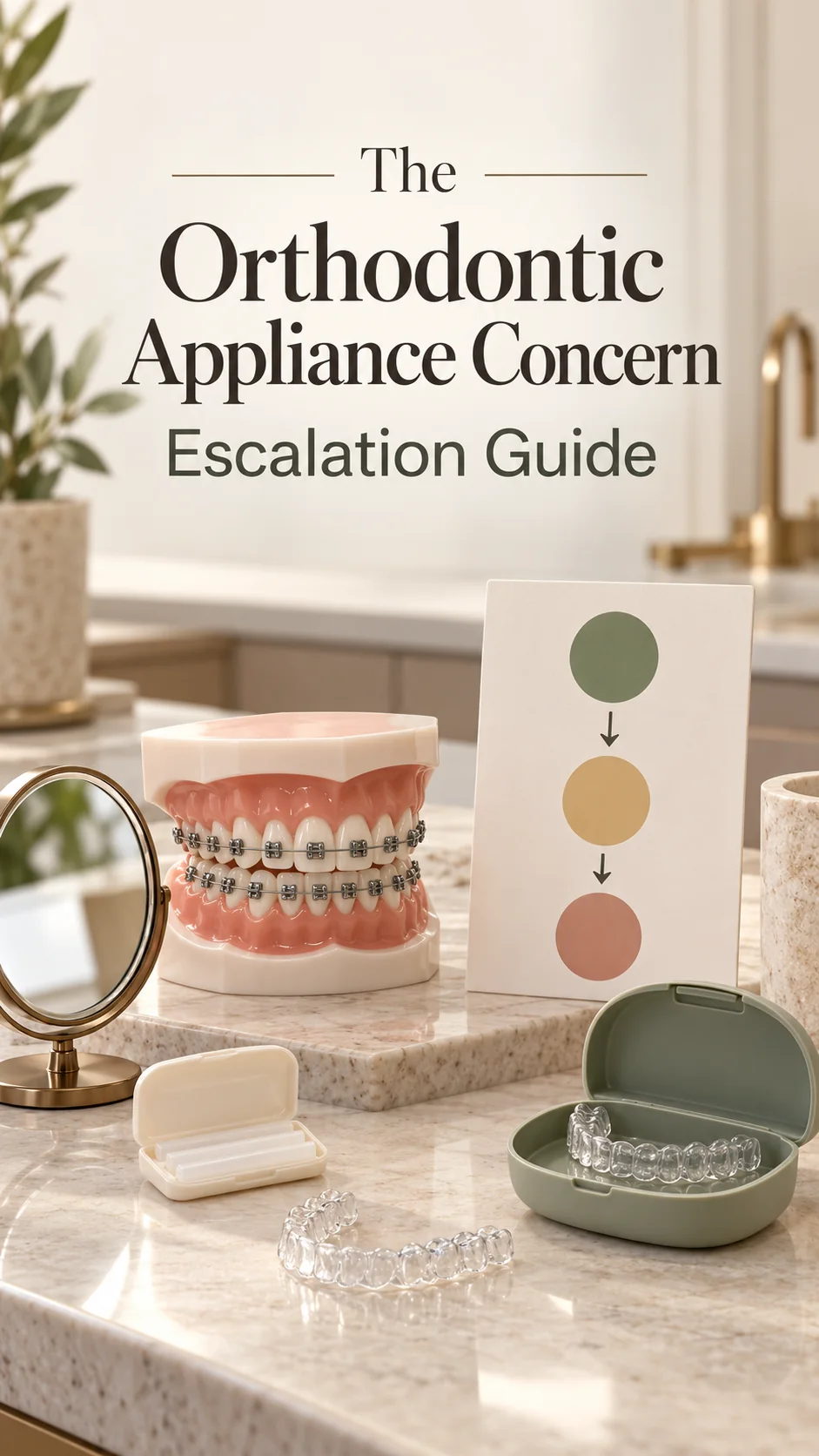
The Orthodontic Appliance Concern Escalation Guide
A practical three-level tool for patients, families, and orthodontic support teams when braces, wires, aligners, retainers, or appliances raise a concern
Made for This • Orthodontic Clinical Care • October 29, 2026
An appliance concern can sound simple—“the wire feels sharp” or “the tray is cracked”—but the next step depends on what is happening around it. Most orthodontic problems are uncomfortable rather than life-threatening, yet some symptoms or injuries require immediate medical or dental attention. A clear escalation guide helps patients, families, and support staff separate those situations without asking an unlicensed team member to diagnose, adjust an appliance, prescribe care, or treat pain.
Why Escalation Language Matters
Unexpected orthodontic problems often occur away from the office. A bracket may loosen during dinner, an aligner may become distorted, or a fixed appliance may feel different after a fall. Without a shared framework, one person may dismiss a concern while another treats every loose component as an emergency. Neither reaction gives the treating orthodontist the clean information needed to make an individualized decision.
The American Association of Orthodontists describes an orthodontic emergency as an acute problem involving braces, aligners, or another appliance that needs attention sooner than the next scheduled visit. AAO guidance also separates true medical or dental emergencies from urgent orthodontic problems. This distinction is the foundation of today’s printable resource: red means seek urgent help, amber means contact the orthodontic office promptly, and green means follow the existing plan while recording questions and changes.
Red: Health and Safety Come First
The red level is intentionally short. AAO emergency guidance identifies trouble breathing or swallowing, heavy or uncontrolled bleeding, suspected jaw fracture or major facial trauma, and a permanent tooth that is knocked out or severely displaced as reasons to call 911 or seek urgent medical or dental care. Sudden severe pain with facial swelling, fever, or signs of infection also deserves urgent assessment.
The guide does not ask a patient or support employee to determine the diagnosis. It asks them to recognize a safety signal and use the appropriate emergency route. Once the person is safe, the orthodontist should be informed so the treatment plan and any damaged appliance can be evaluated.
Amber: Prompt Orthodontic Contact
Many appliance problems belong in the amber level. AAO materials advise informing the orthodontist about a loose or broken bracket, a poking or loose wire, a loose band or appliance, a lost or damaged aligner or retainer, and unusual discomfort. These issues may not require an emergency department, but they should not be silently held until the next routine appointment.
The orthodontic office decides whether the patient needs a comfort visit, an earlier appointment, or specific temporary instructions. That decision depends on the appliance, treatment stage, symptoms, and what the orthodontist can confirm. The resource therefore tells the patient to contact the office and describe what happened rather than offering a universal repair.
Green: Record, Follow, and Recheck
Green does not mean “ignore it.” It means there is no obvious red-flag symptom and no known damaged or missing appliance, so the patient should continue following the treating orthodontist’s established instructions and record the concern. Examples may include a routine question about wear, a reminder needed for the next visit, or mild expected tenderness already covered by the office’s aftercare guidance.
If the situation changes, fit worsens, discomfort increases, or the patient is uncertain, the concern moves to amber. The treating orthodontic office remains the correct place to confirm whether an observation is routine. A color level is a communication aid, not a clinical verdict.
What to Report When Calling
A useful call starts with observable facts. The patient or family member can name the appliance, explain when the change began, describe what they can see, and report symptoms in their own words. If the office permits secure photos through its portal, the team can explain how to submit one. Protected health information should not be sent through an unapproved personal account or public message.
A concise report might be: “The lower right bracket began sliding on the wire after dinner. There is irritation inside the cheek, no facial injury, and breathing and swallowing are normal.” That sentence does not diagnose the problem, but it gives the orthodontic team a clearer starting point.
The Clinical Support Team’s Boundary
Orthodontic support staff may receive the first phone call, document the concern, review the office’s approved script, identify a red-flag statement that needs immediate escalation, and route the message to the treating professional. They should not independently decide that an appliance is safe, cut or bend a wire without authorization and permitted scope, prescribe medication, diagnose infection, or promise that waiting will not affect treatment.
Scope and supervision rules vary by state, credential, and job level. DANB’s state-requirements resource helps teams locate jurisdiction-specific titles, education pathways, and allowable duties. Ohio’s dental-board materials likewise distinguish functions and supervision requirements for different auxiliary roles. The safest workflow combines state rules, the practice’s written policy, and the licensed treating professional’s direction.
An Illustrative Handoff
Imagine a parent reports that an expander feels loose after a child bumped their face during sports. The support employee first asks whether there is difficulty breathing or swallowing, heavy bleeding, a visibly displaced tooth, or suspected major facial injury. If any red signal is present, the family is directed to urgent care according to office policy. If not, the concern is documented as amber and routed promptly to the orthodontist.
The employee records the time of injury, appliance involved, visible change, symptoms, and the safest callback number. They do not tell the parent to turn, tighten, remove, or repair the appliance. The orthodontist decides what evaluation and instructions are appropriate.
How to Use the Guide
Keep the one-page guide near the phone, at the front desk, in a new-hire binder, or as a screenshot on a family phone. The office should add its regular and after-hours contact routes before distributing it. Teams can use the lower section as a standardized concern report so the same essential details reach the clinician every time.
During training, supervisors can role-play one green, one amber, and one red scenario. The goal is not to memorize treatment advice. It is to practice calm language, accurate documentation, privacy-aware communication, and timely escalation.
Career Relevance for Beginners
Beginners often believe competence means knowing the answer immediately. In orthodontic clinical care, professional judgment also means recognizing when a question belongs to the treating orthodontist or emergency provider. A trainee who can listen without minimizing, identify a safety signal, document facts, and hand off cleanly adds real value to the team.
This resource can support interview preparation and onboarding because it demonstrates a repeatable communication process. It also gives supervisors a fair coaching standard: the employee is evaluated on accurate routing and boundaries, not on making independent clinical decisions.
Practical Takeaway
When an orthodontic appliance concern appears, the most useful first step is organized communication. Protect health first, contact the orthodontic office promptly for damaged appliances or unusual symptoms, and keep routine questions visible instead of forgotten. The guide below helps people act with urgency when needed and restraint when diagnosis belongs to the treating professional.
PRACTICAL RESOURCE
THE ORTHODONTIC APPLIANCE CONCERN ESCALATION GUIDE
Use this guide with your orthodontic office’s written instructions. It supports communication; it does not diagnose a problem or replace individualized care.
RED • SEEK URGENT MEDICAL OR DENTAL HELP
Call 911 or seek urgent care for:
☐ Trouble breathing or swallowing
☐ Heavy or uncontrolled bleeding
☐ Suspected broken jaw or major facial trauma
☐ Permanent tooth knocked out or severely displaced
☐ Sudden severe pain with facial swelling, fever, or signs of infection
After immediate safety needs are addressed, notify the treating orthodontist.
AMBER • CONTACT THE ORTHODONTIC OFFICE PROMPTLY
☐ Loose or broken bracket
☐ Poking, loose, or displaced wire
☐ Loose band, expander, space maintainer, or other appliance
☐ Lost, cracked, warped, sharp, painful, or poorly fitting aligner/retainer
☐ Unusual discomfort, mouth irritation, or bite/fit change
☐ Injury involving braces, aligners, teeth, mouth, or appliance
Do not force, trim, glue, bend, turn, remove, or repair an appliance unless the treating office specifically instructs you. Follow the office’s regular and after-hours directions.
GREEN • FOLLOW THE EXISTING PLAN AND RECORD THE QUESTION
No red flag and no known damaged/missing appliance:
☐ Continue the treating orthodontist’s established wear and care instructions.
☐ Write down what changed, when it started, and what you want to ask.
☐ Move to amber if fit changes, discomfort increases, damage appears, or you are unsure.
CONCERN REPORT
Patient: __________________________ Date/time noticed: __________________
Appliance: ☐ Braces ☐ Wire/bracket ☐ Aligner ☐ Retainer ☐ Expander ☐ Other: ______
What happened? __________________________________________________________________
What can you see? _________________________________________________________________
Symptoms in the patient’s own words: _______________________________________________
Breathing/swallowing normal? ☐ Yes ☐ No Heavy bleeding? ☐ Yes ☐ No Facial trauma? ☐ Yes ☐ No
Photo submitted through approved office method? ☐ Yes ☐ No ☐ Not requested
Office contacted: __________________ Staff member: __________________ Time: __________
Instructions received / clinician notified: __________________________________________
Follow-up date or callback plan: ____________________________________________________
SUPPORT-TEAM SCOPE REMINDER
Document facts, use the approved script, protect privacy, recognize red-flag statements, and route the concern. Support staff do not independently diagnose, adjust appliances, prescribe care, treat pain, or promise a clinical outcome.
OFFICE CONTACT
Regular hours: ______________________________ After hours: __________________________
A Useful Next Step
If this escalation guide helps you organize a patient concern or staff-training conversation, browse the Made for This guides at https://madeforthisblog.web.app/shop.html and choose the resource that best supports your next practical step. Availability can change; this package does not claim a specific guidebook is published.
PLANNED GUIDEBOOK ROADMAP
Part 1 — Orthodontic Foundations and Vocabulary (planned)
Part 2 — Patient Communication and Comfort Escalation (planned)
Part 3 — Room Readiness, Infection Prevention, and Handoffs (planned)
Part 4 — Career Pathways, State Scope, and New-Hire Orientation (planned)
Part 5 — Printable Patient Care and Clinical Support Templates (planned)
No part is represented here as published unless separately verified.
SOURCES
American Association of Orthodontists. “What Is an Orthodontic Emergency?” Accessed October 29, 2026. https://aaoinfo.org/whats-trending/what-is-an-orthodontic-emergency/
American Association of Orthodontists. “Living with Braces: Food, Oral Hygiene, & Care Tips.” Accessed October 29, 2026. https://aaoinfo.org/whats-trending/life-during-treatment/
American Association of Orthodontists. “My Retainer Feels Tight or Doesn’t Fit. Should I Force It?” Accessed October 29, 2026. https://aaoinfo.org/whats-trending/my-retainer-feels-tight-can-i-still-wear-it/
Dental Assisting National Board. “State Dental Assisting Requirements.” Accessed October 29, 2026. https://www.danb.org/state-requirements
Ohio State Dental Board. “Expanded Function Dental Auxiliary — Permissible Practices.” Accessed October 29, 2026. https://dental.ohio.gov/licensing-and-renewal/005-expanded-function-dental-auxiliary