
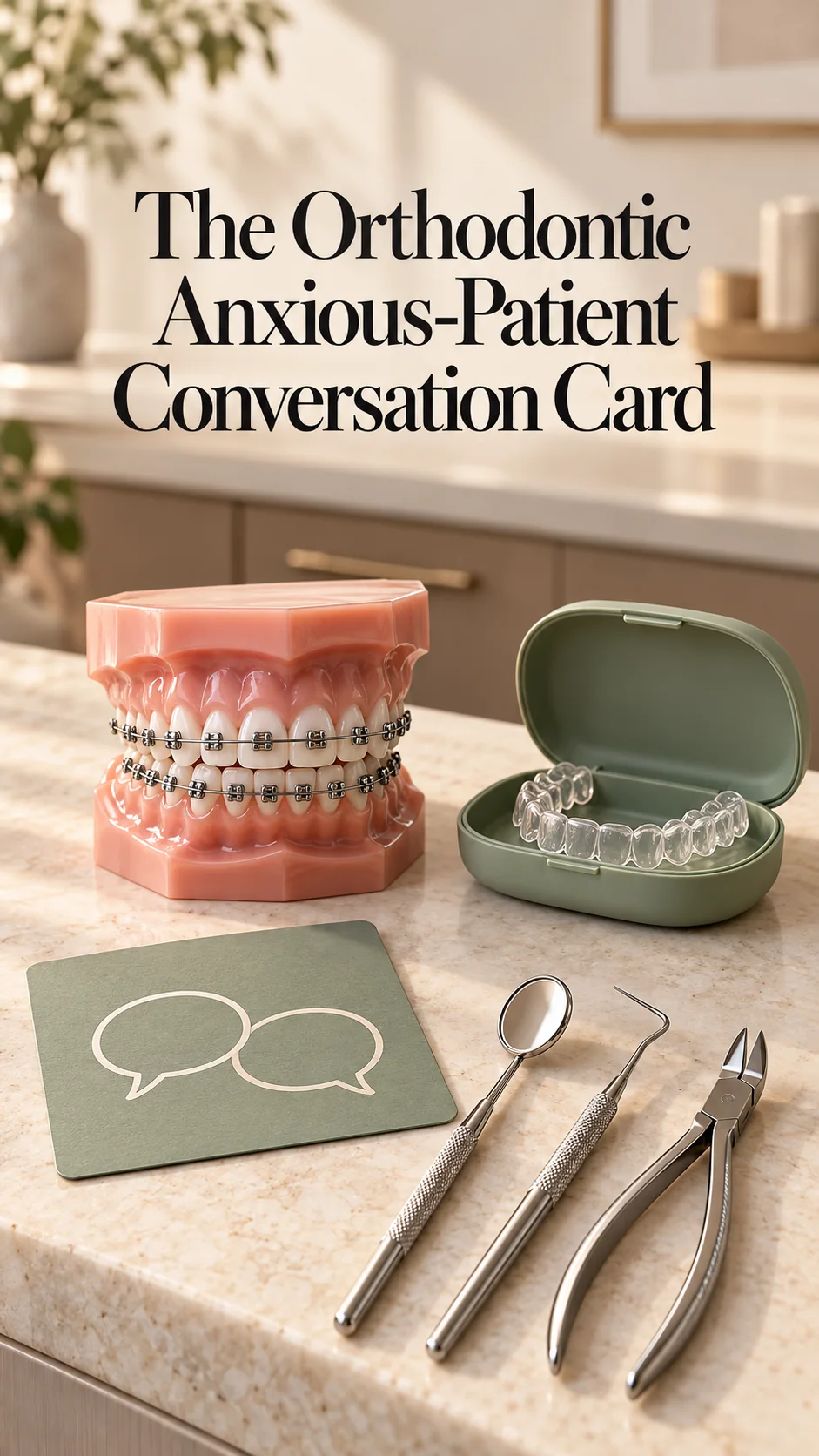
The Orthodontic Anxious-Patient Conversation Card
A beginner’s guide to calm language, clear permission, and clinician handoff
Made for This • Orthodontic Clinical Care • October 21, 2026
An anxious patient rarely needs a perfect speech. They need a team member who slows the room down, explains the next step in ordinary language, and makes it safe to ask for a pause. That is the purpose of today’s Orthodontic Clinical Care resource: a compact conversation card with short, adaptable scripts for greeting, previewing, checking permission, and handing clinical questions to the treating orthodontist. It is a communication aid, not a consent form, diagnosis tool, or substitute for office policy.
Why the words before the procedure matter
Uncertainty can make an orthodontic visit feel harder than the physical steps themselves. The American Association of Orthodontists describes the first visit as a chance to ask questions, discuss concerns, and build rapport with the orthodontist and team. A recent AAO patient article also urges people to speak up about unusual discomfort, broken appliances, poor aligner fit, or questions they do not understand. A support team that invites those questions early is more likely to hear the information the licensed clinician needs.
A script helps beginners avoid two common mistakes: flooding the patient with detail and making promises no one can guarantee. “This will not hurt” may sound reassuring, but it dismisses the patient’s worry and cannot predict an individual experience. A better opening is specific and limited: “I’ll explain one step at a time. If you want me to pause, raise your left hand.” The patient knows what will happen next and how to communicate without interrupting the appointment flow.
Use permission as a process, not a slogan
Simple permission checks are useful before routine supportive actions: “Would you like a quick overview before we begin?” or “Is it okay if I recline the chair now?” These phrases respect the person in the chair and can surface a concern before it becomes distress. They do not replace informed consent. ADA guidance states that informed consent is a discussion, not merely a signature, and that the dentist must conduct the informed-consent conversation for proposed treatment. Clinical support staff may reinforce approved information and route questions, but they should not present themselves as the person authorizing, prescribing, or independently changing care.
With children and teens, include the patient in age-appropriate communication even when a parent or guardian is present. Ask the young patient what would help, then follow the practice’s policy for guardian consent and clinician involvement. If the patient refuses, withdraws permission, or asks a question about risks, alternatives, appliance changes, medication, or whether treatment should continue, pause and bring in the treating orthodontist or another appropriately licensed professional.
Preview one step and create a pause signal
A useful preview names only the immediate action and its purpose. An illustrative example is: “I’m going to place the cheek retractor so the orthodontist can see clearly. It may feel like firm pressure. Raise your left hand if you need a break.” The exact wording and task must match the team member’s assigned duties, training, supervision, and office protocol. The script should never be used to perform a task the worker is not authorized to do.
Pause signals work best when they are agreed upon before the patient is reclined or has instruments in the mouth. The team member should acknowledge the signal when it is used and avoid framing a pause as an inconvenience. If anxiety remains high, the safest response may be a clinician conversation, a different pace, or a rescheduled plan determined by the treating professional. The card supports that handoff; it does not prescribe anxiety treatment.
Respond to discomfort without diagnosing it
When a patient reports pain or an appliance problem, start with neutral listening: “Tell me where you notice it and when it started.” Reflect the answer without converting it into a conclusion: “You’re feeling sharp irritation on the lower left, and it began last night.” Then notify the treating clinician according to office policy. Support staff should not announce that a wire must be cut, a bracket must be moved, an aligner schedule must change, or medication should be taken unless a licensed professional has assessed the situation and the direction is within the worker’s lawful role.
AAO guidance tells patients to contact the orthodontic office about a loose bracket, poking wire, lost aligner, tight retainer, or unusual discomfort so the office can determine the next step. That is the right boundary for the card: invite accurate reporting, keep the patient informed about the handoff, and let the treating clinician decide what the report means.
Protect privacy and document the handoff
An anxious patient may share information they do not want repeated across an open clinic. Move sensitive conversation to an appropriate private setting when possible, use only practice-approved communication channels, and follow the office’s privacy procedures. The ADA Code of Ethics connects patient autonomy with meaningful involvement in treatment decisions and the protection of privacy. Neutral documentation should record what the patient said, the observable context, the person notified, and the instruction or next step given by the licensed clinician.
The editorial term “orthodontic clinician” in this series is an educational umbrella, not a single nationally standardized or independently licensed credential. Orthodontists and other licensed treating professionals diagnose, treatment-plan, prescribe, and authorize care. Assistants, technicians, and other support staff work within state-specific duties, credentials, delegation, and supervision. DANB directs candidates to check their state requirements; Ohio law, for example, authorizes the state dental board to define assistant duties and training standards rather than granting one uniform national scope.
Career relevance for a new team member
Interviewers often learn more from a scenario than from a memorized job description. A strong beginner response to “What would you do with a very anxious patient?” is to acknowledge the concern, explain one step at a time, agree on a pause signal, stay within assigned duties, and involve the treating orthodontist when the patient asks a clinical or consent question. That answer demonstrates empathy, boundaries, teamwork, and respect for patient autonomy without claiming independent authority.
Practical takeaway
Use the card as a rehearsal tool before the clinic day and as a quick prompt during orientation. Keep sentences short, describe only the next step, ask permission, honor the pause signal, and hand clinical decisions to the licensed treating professional. Calm communication is not about talking a patient out of fear. It is about making the visit understandable enough for the patient to participate honestly and for the team to respond safely.
Orthodontic Clinical Care roadmap
This is Part 9 of a developing educational roadmap. Earlier parts covered first appointments, adjustment visits, broken appliances, retainer delivery, aligner check-ins, and symptom reporting. Planned parts will add room-ready workflows, privacy reminders, clinician-team handoff sheets, interview pages, and training-pathway maps. Planned parts remain planned until they are actually published; this edition does not claim that a guidebook is available.
Next step: For another practical next step, browse the Made for This guides at https://madeforthisblog.web.app/shop.html and choose a resource that supports your current learning goal.
The Orthodontic Anxious-Patient Conversation Card
Printable chairside script card for support staff and beginners
Scope note: Adapt these words to office policy and the patient. This card supports communication; it does not replace informed consent, diagnosis, individualized advice, or the treating orthodontist’s clinical direction.
Open | “I’m glad you told me. I’ll explain one step at a time.” |
Permission + preview | “Next I’ll __________ so the orthodontist can __________. Is that okay?” |
Pause signal | “If you want me to pause, raise your left hand.” |
When the patient says “I’m scared” | “Thank you for telling me. Is there one part you’re most worried about?” |
When discomfort is reported | “Tell me where you notice it and when it started.” |
Clinician handoff | “I’m going to share that with the treating orthodontist so they can assess the next step.” |
Avoid | “This won’t hurt.” “There’s nothing to worry about.” “You’ll be fine.” “Just relax.” |
Document | Patient’s words: ______________________________ |
Pause and involve the treating orthodontist or another appropriately licensed professional for questions about risks, alternatives, medication, appliance changes, whether treatment should continue, or concerns outside your assigned duties. Follow office emergency procedures for urgent symptoms.
Sources
American Association of Orthodontists — What to Expect at Your First Orthodontic Appointment (April 17, 2026): https://aaoinfo.org/whats-trending/first-orthodontic-appointment/
American Association of Orthodontists — What Your Orthodontist Wishes You Knew (October 13, 2026): https://aaoinfo.org/whats-trending/what-your-orthodontist-wishes-you-knew/
American Dental Association — Types of Consent (accessed October 21, 2026): https://www.ada.org/resources/practice/practice-management/types-of-consent
American Dental Association — 2023 Principles of Ethics and Code of Professional Conduct: https://www.ada.org/-/media/project/ada-organization/ada/ada-org/files/about/ada_code_of_ethics.pdf
Dental Assisting National Board — Ohio Dental Assistant Requirements (accessed October 21, 2026): https://www.danb.org/state-requirements/detail/ohio-state-requirements
Dental Assisting National Board — Certified Orthodontic Assistant Eligibility Pathways (accessed October 21, 2026): https://www.danb.org/exams/exam/coa-exam
Ohio Revised Code §4715.39 — Permitted Duties (effective December 29, 2023; accessed October 21, 2026): https://codes.ohio.gov/ohio-revised-code/section-4715.39