
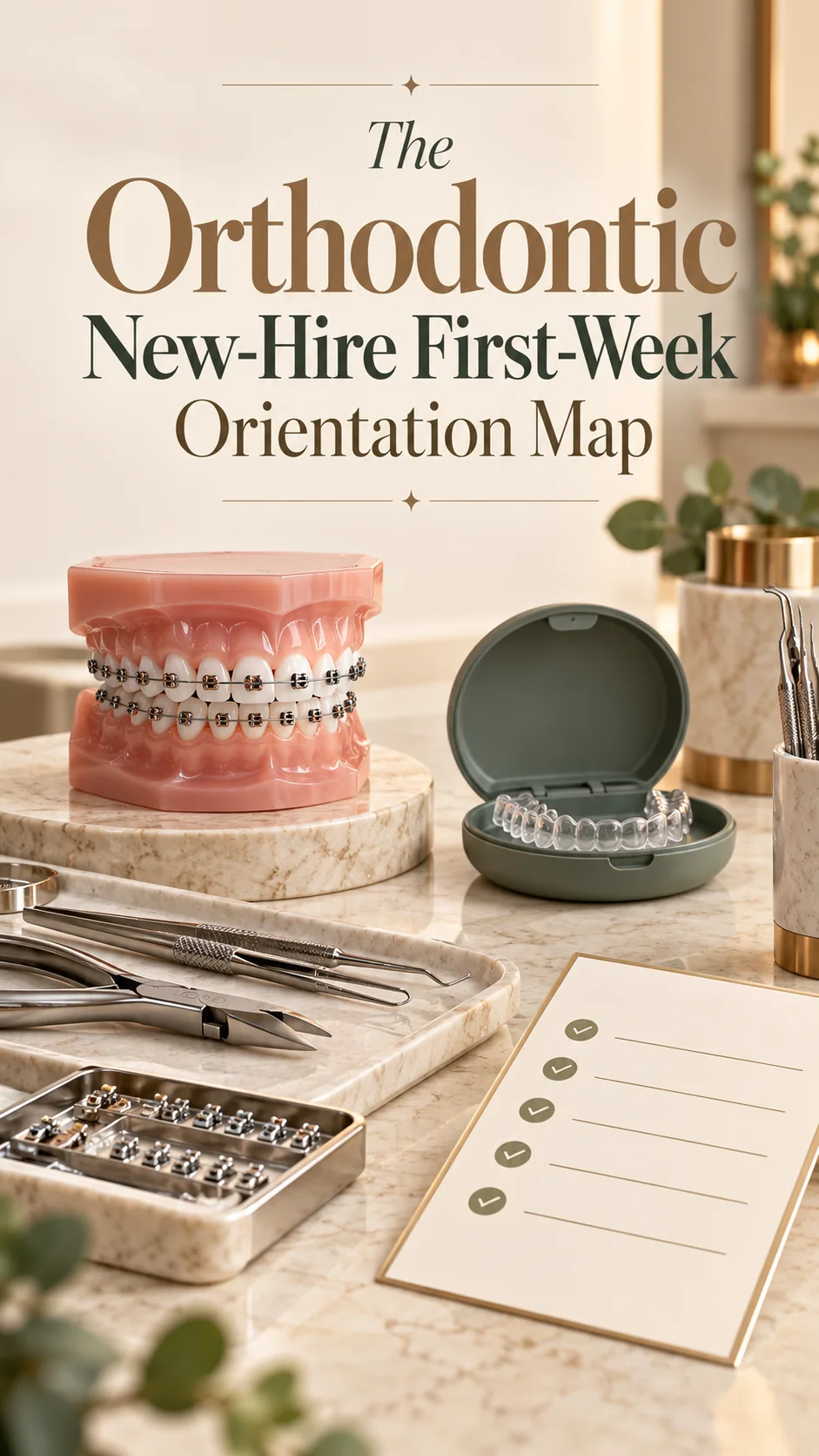
The Orthodontic New-Hire First-Week Orientation Map
A practical five-day guide for entering orthodontic clinical care with clarity, safety, and professional confidence
Made for This • Orthodontic Clinical Care • October 27, 2026
A new orthodontic team member can learn the names of instruments quickly and still feel lost when the clinic begins to move. The difficult part is not memorizing isolated facts; it is understanding the sequence of a patient visit, knowing who owns each decision, and recognizing when a question must move to the treating orthodontist. A first-week orientation map makes those expectations visible. It turns “watch and learn” into a paced plan that protects patients while helping a beginner become useful without pretending to be ready for duties that require authorization, training, credentials, or supervision.
Why the First Week Needs a Map
Orthodontic care is a long treatment journey made up of many short appointments. A patient may arrive with braces, clear aligners, an expander, elastics, or a retainer, and the purpose of the visit may not be obvious to a new team member. The American Association of Orthodontists explains that brackets, archwires, elastics, aligners, and retainers play different roles in treatment. Orientation should therefore begin with vocabulary and visit flow, not with permission to perform procedures.
A map also makes the hidden work visible. It identifies where a patient checks in, how the clinical team reviews the schedule, who confirms consent, where protected information may be discussed, how rooms are prepared, how instruments move through reprocessing, and how questions are handed to the licensed treating professional. When these steps are taught as one connected system, a new hire can see how professionalism, privacy, infection prevention, and communication support the clinical outcome.
Start With Boundaries, Not Buttons
“Orthodontic clinician” is useful series language, but it is not one nationally standardized credential. Orthodontists and other licensed treating professionals make diagnostic and treatment decisions. Clinical support staff, assistants, and technicians work within duties that vary by state, credential, training, and required supervision. DANB’s state-requirements resource is a practical starting point because it organizes job titles, education pathways, examinations, and allowable duties by jurisdiction.
That distinction belongs on day one. A new hire should know that observing a procedure is not the same as being authorized to perform it. An employee should not independently diagnose an appliance problem, alter a wire or bracket, select treatment, prescribe care, or treat pain. When a task is unfamiliar or its permission is unclear, the correct professional response is to pause and ask the supervising clinician. The Ohio State Dental Board’s auxiliary-duty materials illustrate why a local check matters: permissible functions depend on specific education, examination, experience, and supervision requirements.
Turn the Clinic Into a Sequence
A strong orientation week moves from context to controlled participation. On the first day, the new hire learns the team structure, emergency contacts, privacy expectations, and the route a patient follows through the practice. The second day focuses on room flow and infection-prevention observation. CDC Standard Precautions are designed both to protect dental health care personnel and to prevent the spread of infection among patients; a beginner needs to see the office’s written protocols and manufacturer instructions before handling reprocessing tasks.
By midweek, the learner can begin practicing nonclinical communication and approved documentation workflows under supervision. That might mean confirming how the practice records a patient’s stated concern, learning the approved handoff format, or rehearsing how to say, “I’m going to bring that question to the orthodontist.” The goal is accuracy, not speed. A good orientation never turns the patient into a practice exercise or assumes that watching once equals competency.
Communication Is a Safety Skill
Orthodontic patients often describe sensations in everyday language: “the wire feels sharp,” “this tray is not seating,” or “my retainer feels different.” The support team’s job is to listen, document the patient’s own words, identify whether the situation needs prompt escalation under office policy, and route clinical questions to the treating orthodontist. The team should not minimize discomfort, promise a result, or substitute general advice for individualized assessment.
Consider an illustrative example. A new team member hears a parent say that a child cannot close their mouth comfortably after an appliance concern. Instead of guessing at the cause or suggesting an adjustment, the learner uses the office’s escalation path: remain calm, record the concern accurately, alert the designated clinical lead, and support the orthodontist’s instructions. That response is both empathetic and appropriately limited.
How to Use the Orientation Map
The resource below is designed for a supervisor and new hire to use together. At the beginning of each day, choose the observation goals and clarify which activities are watch-only, practice-only, or permitted under direct supervision. At the end of the day, record questions and identify one skill that needs more explanation. A check mark means the topic was reviewed; it does not certify competency or expand scope.
The map should be customized to the practice’s state rules, job descriptions, written infection-prevention plan, privacy procedures, and emergency protocols. It should also name the person responsible for each handoff. This prevents the vague instruction to “ask somebody” and creates a reliable route for concerns involving discomfort, loose appliances, privacy, consent, contaminated instruments, or uncertain duties.
A Career Signal Worth Noticing
For people considering orthodontic clinical support work, the first week reveals what the role truly values. Manual skill matters, but so do careful listening, clean documentation, respect for supervision, emotional steadiness, and the willingness to ask before acting. A candidate who wants to contribute safely should be comfortable saying, “I don’t know yet, but I know who to ask.”
Supervisors can use the same map as a recruitment tool. It demonstrates that the practice has a structured learning culture instead of expecting a beginner to improvise. That clarity can improve coaching conversations and make performance expectations fairer. It also gives the new hire a concrete foundation for a 30-day learning plan without overstating readiness.
Practical Takeaway
A first-week map is not a shortcut to clinical competence. It is a guardrail that helps a beginner understand the patient journey, learn the clinic’s systems, and build confidence in the correct order. The most useful new hire is not the person who acts fastest; it is the person who recognizes boundaries, communicates clearly, follows written protocols, and escalates questions to the right professional.
PRACTICAL RESOURCE
ORTHODONTIC NEW-HIRE FIRST-WEEK ORIENTATION MAP
Use with a supervisor. Customize to state law, credentials, office policy, and required supervision. A check mark confirms review—not authorization or competency.
DAY 1 • PEOPLE, PATH, AND PROFESSIONAL BOUNDARIES
☐ Meet the orthodontist, clinical lead, infection-prevention coordinator, privacy contact, and emergency contact.
☐ Walk the patient route: arrival → records review → clinical area → licensed-provider assessment → checkout.
☐ Review job description, supervision level, state requirements, privacy rules, consent process, and how to decline an unclear duty.
☐ Learn the approved phrase: “I’m going to bring that question to the treating orthodontist.”
DAY 2 • ROOM FLOW AND INFECTION PREVENTION
☐ Observe room setup and turnover using the practice’s written protocol.
☐ Locate PPE, hand-hygiene supplies, sharps controls, exposure plan, and manufacturer reprocessing instructions.
☐ Trace clean-to-contaminated instrument flow; perform only assigned tasks after training and under required supervision.
☐ Ask: Who stops the process when packaging, indicators, equipment, or surfaces raise a concern?
DAY 3 • RECORDS, PRIVACY, AND HANDOFFS
☐ Learn approved charting fields and how to record a patient’s words without diagnosing.
☐ Practice a concise handoff: patient concern + appliance + timing + observed facts + person notified.
☐ Review where protected information may be discussed and which consent questions go to the treating team.
☐ Shadow the schedule huddle and identify the decision-maker for each visit type.
DAY 4 • ORTHODONTIC VISIT WORKFLOWS
☐ Shadow one braces visit, one aligner or retainer visit, and one appliance-concern pathway when available.
☐ Identify brackets, archwires, elastics, aligners, retainers, and the practice’s approved terminology.
☐ Separate observation, permitted support, and clinician-only decisions.
☐ Rehearse escalation for discomfort, a loose or damaged appliance, swelling, trauma, difficulty breathing or swallowing, or any uncertainty.
DAY 5 • SUPERVISED PRACTICE AND NEXT STEPS
☐ Demonstrate approved nonclinical workflows and any authorized task only under the required supervision.
☐ Review questions, near-misses, and topics that need retraining—without blame.
☐ Confirm what remains watch-only, what requires credentials, and what may be performed after documented competency.
☐ Set three 30-day goals: one workflow, one communication skill, and one regulation or policy to study.
STOP • ASK • ESCALATE
Stop when a duty, consent status, infection-control step, patient condition, or supervision requirement is unclear. Ask the designated supervisor. Escalate clinical questions, pain or discomfort concerns, damaged appliances, trauma, swelling, or breathing/swallowing difficulty promptly under office policy. Support staff do not independently diagnose, adjust appliances, prescribe care, or treat pain.
SUPERVISOR: ____________________ NEW HIRE: ____________________ WEEK OF: __________
QUESTIONS TO REVISIT: ____________________________________________________________
30-DAY FOLLOW-UP DATE: ____________________
A Useful Next Step
If this orientation map helps you identify what your clinic or learning plan still needs, browse the Made for This guides at https://madeforthisblog.web.app/shop.html and choose the resource that best supports your next practical step. Availability can change; this article does not claim a specific guidebook is published.
PLANNED GUIDEBOOK ROADMAP
Part 1 — Orthodontic Foundations and Vocabulary (planned)
Part 2 — Patient Communication and Comfort Escalation (planned)
Part 3 — Room Readiness, Infection Prevention, and Handoffs (planned)
Part 4 — Career Pathways, State Scope, and New-Hire Orientation (planned)
Part 5 — Printable Clinical Support Templates (planned)
No part is represented here as published unless separately verified.
SOURCES
American Association of Orthodontists. “Glossary of Orthodontic Terms.” Accessed October 27, 2026. https://aaoinfo.org/resources/glossary-of-orthodontic-terms/
Centers for Disease Control and Prevention. “Standard Precautions.” May 15, 2024. https://www.cdc.gov/dental-infection-control/hcp/summary/standard-precautions.html
Centers for Disease Control and Prevention. “Administrative Considerations.” May 15, 2024. https://www.cdc.gov/dental-infection-control/hcp/summary/administrative-considerations.html
Dental Assisting National Board. “State Dental Assisting Requirements.” Accessed October 27, 2026. https://www.danb.org/state-requirements
Dental Assisting National Board. “Are You Allowed to Do That? Why Dental Assistants Must Know Their Allowable Duties.” April 9, 2025. https://www.danb.org/news-blog/detail/blog/why-dental-assistants-must-know-their-allowable-duties
Ohio State Dental Board. “Consolidated Auxiliary Duties Matrix.” Accessed October 27, 2026. https://dental.ohio.gov/wps/wcm/connect/gov/642817d2-4da3-48d2-9ed8-88ab1870998b/Consolidated%2BAuxiliary%2BDuties%2B%28CAD%29%2BMatrix.pdf