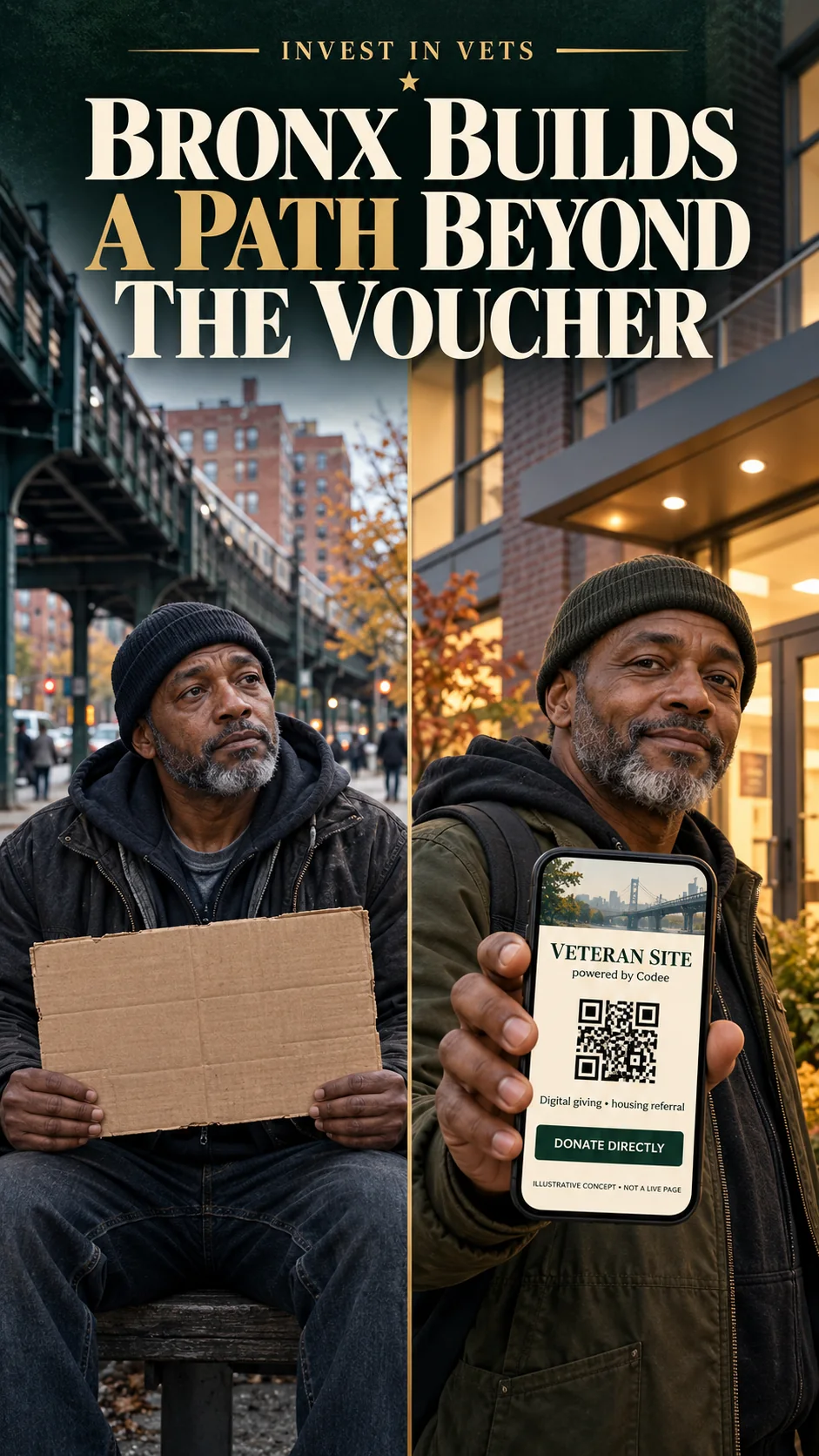
INVEST IN VETS • LOCAL HOUSING CASE STUDY
BRONX, NEW YORK | VERIFIED CASE STUDY | OCTOBER 18, 2026
Bronx Builds a Path Beyond the Voucher
River Avenue Apartments II shows why housing supply, service funding, landlord participation, benefits access and privacy-safe outreach must move together.
Cover disclosure: The Veteran is fictional/composite. The phone page and QR are illustrative concepts, not a live recipient page. No donation result is represented.
Verified project snapshot
PROJECT STATUS | Under construction; not represented as open or occupied |
TOTAL HOMES | 292 affordable apartments in the March 31, 2026 state announcement |
SUPPORTIVE HOMES | 173 with on-site services |
VETERAN SET-ASIDE | 8 supportive units identified in draft state board minutes: 3 for Veterans and 5 for Veterans with serious mental illness |
DEVELOPMENT COST | $225 million reported by New York State |
A Bronx housing project with a defined Veteran door
At 1185 River Avenue in the Bronx, a $225 million affordable-housing development is moving from promise to construction. New York State’s March 31, 2026 announcement describes River Avenue Apartments II as 292 affordable apartments, including 173 supportive homes. Community Access and Blue Sky Bronx are developing the West Concourse project for households earning up to 80 percent of area median income.
The Veteran connection is specific, but it should not be overstated. Draft minutes for the December 3, 2025 meeting of the state Homeless Housing and Assistance Corporation identify eight supportive units reserved for Veterans: three for Veterans and five for Veterans living with serious mental illness. That is eight Veteran-designated units within a 292-apartment development—not 292 Veteran homes, and not evidence that eight Veterans have moved in. As of October 18, 2026, the official sources document a groundbreaking and construction financing, not completion or occupancy.
What is funded—and what is still ahead
The financing shows how permanent supportive housing is assembled locally. The state said the development expects about $90 million in federal and state low-income housing tax-credit equity and $60 million in subsidy from New York State Homes and Community Renewal. The Office of Temporary and Disability Assistance supplied $9.8 million through the Homeless Housing and Assistance Program. Operating and rental support is also layered: 70 supportive apartments are tied to the Empire State Supportive Housing Initiative, while 103 are tied to the city’s NYC 15/15 program.
Community Access is expected to provide counseling, group activities, harm-reduction services, connections to physical and mental health care, medication support and job referrals. The state also identifies 15 mobility-accessible or adaptable apartments and six for residents with hearing or vision disabilities. A lease is only one part of housing stability; a tenant unable to navigate care, benefits or a crisis is still at risk.
The practical gap is timing. A development under construction cannot solve tonight’s homelessness. Bridge options—outreach, shelter and transitional placements, prevention, rapid rehousing and landlord-ready apartments—remain necessary while permanent units are built. A preliminary state housing-finance prospectus anticipated a 40-month construction period, subject to change. Invest in Vets should track construction, leasing, referrals and actual move-ins separately instead of turning a groundbreaking into completed impact.
HUD-VASH works only when a real apartment is available
HUD-VASH combines HUD rental assistance with VA case management and clinical support for eligible Veterans experiencing homelessness. It is not cash paid to a Veteran, it is not the same as VA disability compensation, and it does not make a home automatically rent-free. Eligibility, unit approval, payment standards, tenant contribution and lease requirements still apply. VA reported on April 1, 2026 that HUD-VASH initial income eligibility now uses an 80-percent-of-area-median-income ceiling and excludes service-connected disability compensation from that eligibility calculation, expanding access for some disabled Veterans without converting disability compensation into a housing voucher.
New York City’s Department of Veterans’ Services describes the operational work behind the benefit. Veteran Housing Coordinators help identify apartments, arrange viewings, confirm subsidies and coordinate inspections. House-A-Veteran recruits brokers, owners and managers, while aftercare supports retention. A voucher without a willing owner, passable unit and completed inspection remains assistance on paper.
A strong landlord partnership should offer one accountable contact, plain-language inspection preparation, prompt document collection and a clear path for resolving tenancy problems. It should never pressure a Veteran to disclose a diagnosis to a landlord or donor. Landlords need only the information required for eligibility, tenancy and reasonable-accommodation processes; clinical details belong with authorized care teams. Veterans who deployed may delay asking for help because military identity, pride or stigma makes disclosure feel like failure. Outreach should begin with choice: “Would you like housing navigation, benefits screening, confidential support—or simply information today?”
Privacy and donation safety for a planned Veteran Site
Veteran Site powered by Codee is planned—not represented here as launched—and is intended to be free for eligible, consenting homeless disabled Veterans. The concept is an opt-in personal donation and referral page with a QR code linked to that specific verified page. A participating Veteran could voluntarily link the page to the Veteran’s own authorized Cash App, Zelle or other payment account. Codee intends a 0-percent platform commission; that does not mean the Veteran will receive 100 percent net after possible payment-processor charges, taxes or other account terms.
The safe design standard is minimum necessary data. Publish only what the Veteran knowingly approves, avoid diagnoses and document images, make consent revocable, provide a fast takedown route and separate the public page from the private housing record. A QR code should resolve to the one verified page named on the sign or handout, use HTTPS and display the recipient and payment destination before a donor acts. No page should promise that donations will guarantee housing or that a home will be rent-free.
If a Veteran chooses a trusted helper, informed consent must identify that person and explain custody and control risks. Money received by an intermediary is controlled by the intermediary until transferred; the platform must not describe those receipts as guaranteed to reach the Veteran. Safer practice favors direct, Veteran-authorized payment links, confirmation screens, a fraud-reporting channel and periodic re-verification. Housing referrals to the VA’s National Call Center for Homeless Veterans at 877-424-3838 and to HUD-VASH must remain available even when a Veteran declines donations or declines a public page.
Five verified AI developments—and five limited nonprofit uses
The company announcements below are verified primary-source developments. The nonprofit applications are planning ideas only; none is represented as deployed by Invest in Vets, the Bronx project or Codee. AI should support staff judgment, never decide housing eligibility, clinical need, donor trustworthiness or a Veteran’s right to assistance.
1. OpenAI — OpenAI for Nonprofits update, February 6, 2026
Verified company development: OpenAI said eligible nonprofits could receive discounts of up to 75 percent on ChatGPT Business or Enterprise. Planned nonprofit application: after adopting a data policy, staff could draft landlord outreach, summarize public funding notices and create accessible FAQs using public or de-identified material—not protected case records.
2. Anthropic — independent evaluator access, October 15, 2026 (updated October 16)
Verified company development: Anthropic described giving independent evaluators employee-like access so they could test advanced systems and publish findings. Planned nonprofit application: borrow the governance pattern, not the lab access—ask an independent privacy or legal reviewer to test Codee’s consent, takedown, payment-link and impersonation controls before launch.
3. Google — Jigsaw Sensemaking AI partner program, September 22, 2026
Verified company development: Google announced a program offering local-government partners Jigsaw’s Sensemaking AI to aggregate civic feedback, with no operational cost stated for participating governments. Planned nonprofit application: analyze anonymized themes from landlord and Veteran feedback to identify inspection or referral bottlenecks; never use the tool to rank individual Veterans.
4. Microsoft — Elevate for Changemakers, March 25, 2026
Verified company development: Microsoft announced an AI for Nonprofits credential, training and a fellowship pathway. Planned nonprofit application: require role-based training before staff use AI in housing, benefits or donation workflows, followed by scenario tests covering consent, bias, hallucinated eligibility and escalation to a human.
5. Salesforce — Trusted Enterprise AI Harness, September 10, 2026
Verified company development: Salesforce described a governance layer for identity, permissions, privacy and controls; its announcement also said the unified experience was planned for early fiscal year 2028, so that future element is not current availability. Planned nonprofit application: keep a small AI register naming each tool, permitted data, human owner, blocked decisions, review date and deletion path.
The practical takeaway: run two tracks, measure one outcome
Invest in Vets can adapt a two-track housing launch. The private track is a conversion ledger: referral, consent, eligibility review, benefit connection, voucher issuance where applicable, landlord lead, inspection, lease, move-in and 30/90/180-day retention. Access should be limited by role, and the ledger should record who changed what. The public track is a voluntary Veteran page containing only verified, consented information, direct authorized payment links, a donation-safety notice, housing resources and an immediate pause or removal mechanism. Public engagement must never become a condition of housing help.
Measure the outcome that matters: stable, affordable housing with support—not page views, QR scans or announced units. For River Avenue Apartments II, that means following the eight Veteran-reserved units from construction through referral, lease-up and sustained tenancy, while helping additional Veterans use HUD-VASH and the wider rental market. The model is humble but replicable: build supply, recruit landlords, protect privacy, connect benefits and keep a human accountable at every handoff.
Need help now? Call the VA National Call Center for Homeless Veterans at 877-424-3838 (free and confidential, 24/7) or use the VA and New York City housing resources listed below. If you want to support Invest in Vets’ cause, donate through its official page. A donation supports the mission; it does not guarantee a particular housing outcome, and this article does not make a tax-deductibility claim.
Veteran resources
VA National Call Center for Homeless Veterans — 877-424-3838; free, confidential and available 24/7
VA Bronx homeless Veteran care — local VA access and care information
VA New York Harbor homeless Veteran care — New York City-area services
NYC Department of Veterans’ Services housing initiatives — housing coordinators, House-A-Veteran, HUD-VASH continuum and aftercare
NYC affordable housing resources for Veterans — city housing navigation
Sources and verification notes
New York State: Governor Hochul announces groundbreaking at River Avenue Apartments II — March 31, 2026; 292 apartments, 173 supportive apartments, funding, developers and services
New York State Housing Finance Agency preliminary official statement — 2026; financing table and preliminary 40-month construction estimate
New York Homeless Housing and Assistance Corporation draft board minutes — December 3, 2025; eight Veteran-reserved supportive units identified in draft minutes
VA: HUD-VASH policy change for disabled Veterans — April 1, 2026; income threshold and treatment of service-connected disability compensation
VA Bronx: New York homelessness grants — October 5, 2026; statewide FY2027 SSVF and GPD context, not a claimed River Avenue allocation
OpenAI for Nonprofits — updated February 6, 2026
Anthropic: update on independent evaluators — October 15, 2026; updated October 16, 2026
Google.org: Sensemaking AI partner program — September 22, 2026
Microsoft: Elevate for Changemakers — March 25, 2026
Salesforce: Trusted Enterprise AI Harness — September 10, 2026