INVEST IN VETS • LOCAL HOUSING CASE STUDY
ST LOUIS | VERIFIED VETERAN HOUSING CASE STUDY | OCTOBER 21, 2026
St Louis Expands a Veteran Village
A transitional tiny-home village is adding capacity and outreach while permanent housing remains the destination.
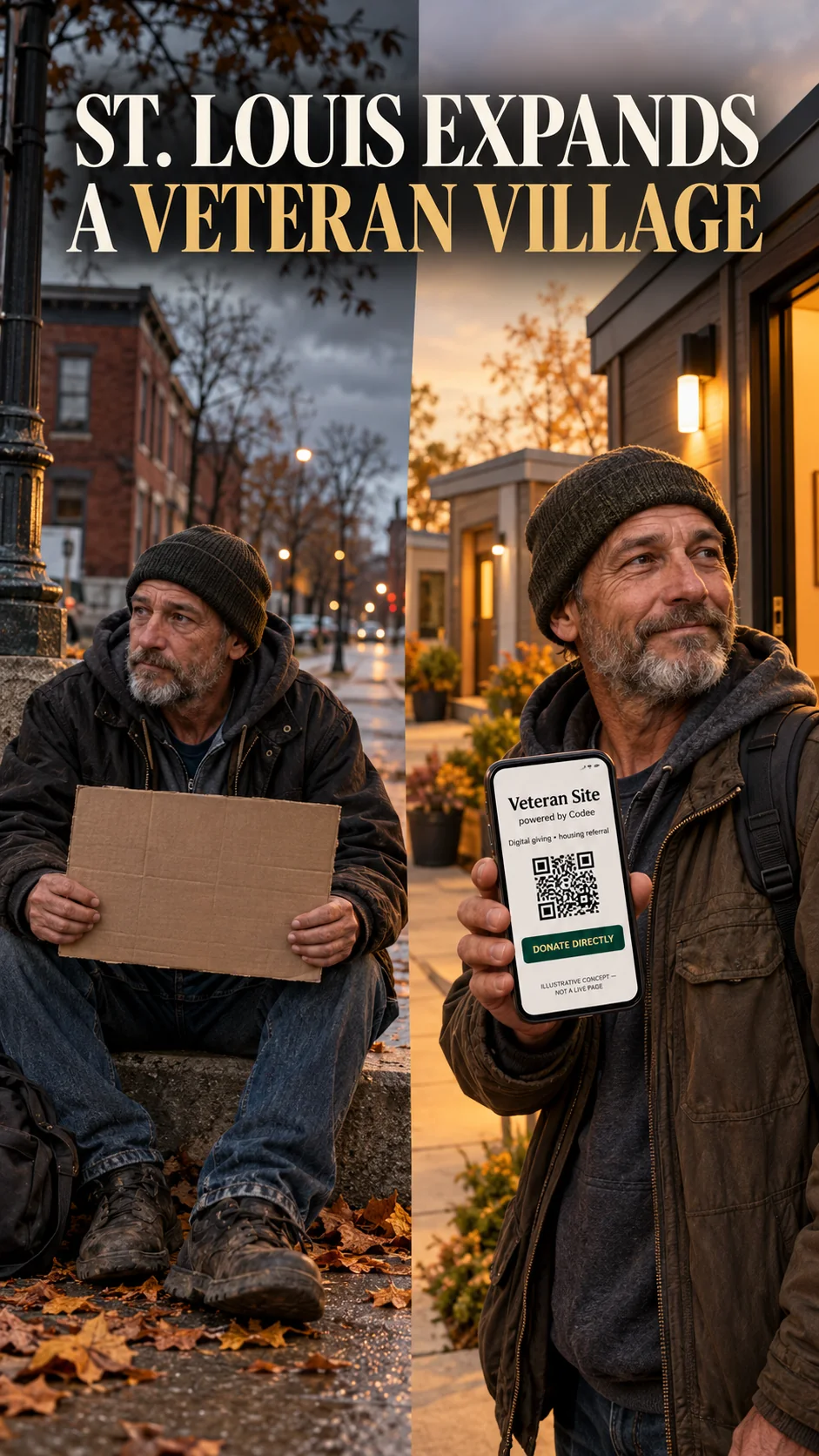
Cover disclosure: The Veteran is fictional/composite. The phone page and QR are illustrative concepts, not a live recipient page. No donation or housing result is represented. No PIT statistic appears on the cover.
Verified project snapshot
LOCATION | Jeff-Vander-Lou neighborhood, St. Louis, Missouri; nearly four acres |
PLANNED BUILDOUT | 50 furnished transitional tiny homes plus a 3,000-square-foot Village Center |
2026 CONSTRUCTION | 16 phase-two homes reported under construction; completion not independently verified as of October 21 |
2025 OUTCOME | 7 Veterans welcomed into transitional homes; 425 served through residential and outreach programs |
PUBLIC LEDGER | City ARPA record lists a $1,149,239 payment to Veterans Community Project on June 6, 2025 |
PERMANENT HOUSING | No permanent apartment-unit total is created by this project; permanent lease-up requires a separate next step |
A real expansion with a clearly defined limit
Veterans Community Project of St. Louis is building a Veteran-specific transitional village in the Jeff-Vander-Lou neighborhood. The operator describes a nearly four-acre campus that, when complete, is planned to contain 50 furnished tiny homes for individuals and families plus a 3,000-square-foot Village Center with a kitchen, wellness areas and classrooms. The same page says the on-site Outreach Center already offers food, hygiene supplies, emergency assistance, benefits navigation and housing referrals. It sits about one mile from the John Cochran VA Medical Center and on a major bus route.
The status is important. Local reporting on February 27, 2026 said 16 phase-two homes were under construction and expected completion roughly a year later. June coverage described the work as an expansion toward 36 homes. Veterans Community Project still presents 50 homes as the completed vision, not the current count. Invest in Vets therefore should describe 16 homes as reported under construction, 36 as an interim expansion figure and 50 as the planned buildout. None of those figures means 50 Veterans are already housed.
Public support is also documented, but it should not be overstated. The City of St. Louis ARPA expenditure page, reporting activity through June 30, 2026 and updated August 13, lists a $1,149,239 payment to Veterans Community Project on June 6, 2025. That record confirms a substantial public expenditure; it does not establish the total development cost, the value of later private donations or a per-home cost.
Transitional shelter must connect to a permanent lease
Veterans Community Project labels these tiny homes transitional. Its 2025 figures report seven Veterans welcomed into the homes and 425 Veterans served through residential and outreach programs. Those are different measures: seven residential placements are not 425 housed Veterans. The broader number includes outreach. The project offers privacy, routine and one-to-one support, but the long-term outcome is still a stable permanent home.
That makes the exit pathway as important as construction. HUD-VASH combines a HUD Housing Choice Voucher with VA case management and supportive services. The voucher is rental assistance, not cash, and it is separate from VA disability compensation. A Veteran must qualify, a landlord must accept the arrangement, the unit must meet inspection standards, the rent must be approved and the Veteran may owe a tenant share. SSVF can separately provide prevention or rapid-rehousing support through qualified grantees. VA does not make direct rent payments to landlords; payments come through the public housing authority or an SSVF provider.
Access without forcing a public story
The St. Louis operator says Veterans can seek outreach regardless of discharge status, length of service or type of service. It asks for military verification such as a DD-214 with photo ID, VA ID or state ID showing military status, while offering help when a Veteran lacks those documents. Residential placement still requires program intake; the outreach promise should not be rewritten as guaranteed admission to a tiny home.
For a deployed or disabled Veteran who avoids help because of pride, identity or stigma, the first contact should preserve choice. A private conversation can offer document recovery, benefits navigation, VA homeless-program referral or HUD-VASH screening without demanding a diagnosis or public testimony. A disability claim is an earned-benefit process; a housing referral cannot depend on a Veteran disclosing service-connected conditions to a landlord, donor or social audience.
Landlords complete the path the village cannot
Transitional villages need landlords willing to accept the handoff. VA advises owners to contact the local public housing authority or VA medical center, share upcoming vacancies, review NSPIRE standards, submit the Request for Tenancy Approval and allow the housing authority to inspect the unit and approve rent before the lease begins. A nonprofit can reduce friction by maintaining a verified vacancy list and giving each participating landlord one accountable contact, but it should never promise approval or payment before the responsible agency confirms it.
Privacy and donation safety for a planned Veteran Site
Veteran Site powered by Codee is planned, not represented as live. It is intended to be free for eligible, consenting homeless disabled Veterans: an opt-in personal donation and referral page with a QR code linking to that specific verified page and voluntary direct links to the Veteran's own authorized Cash App, Zelle or other payment account. Codee intends a 0-percent platform commission, not 100 percent net after possible processor charges, taxes or account terms. Donations cannot be presented as a guarantee of housing, rent or any other outcome.
A safe page should publish only what the Veteran approves, avoid identity documents and diagnoses, show the destination account before a donor acts, and allow immediate pause or removal. If a trusted helper receives funds, informed consent must name that intermediary and explain custody and control risks. Money received by a helper cannot be represented as guaranteed to reach the Veteran. Housing navigation, the VA hotline and HUD-VASH referrals must remain available when a Veteran declines fundraising or public visibility.
Five verified AI developments and five limited nonprofit uses
Each numbered item is a dated company primary source. The nonprofit application is a planning idea only, not a deployed feature. AI must not decide housing eligibility, voucher approval, disability status, donation credibility or whether a Veteran deserves help.
1. OpenAI and Google Cloud model access, October 21, 2026
Verified: OpenAI announced that its frontier models and Codex workflows are coming to Google Cloud Model Garden, with general availability planned in the coming weeks. Planned use: compare governed cloud environments using synthetic or de-identified test records before selecting any tool. No Veteran file should be uploaded merely because a model becomes available.
2. Anthropic Public Benefit Fund, October 18, 2026
Verified: Anthropic announced a new fund backed by a planned equity commitment, subject to stockholder approval, and said governance details will follow. Planned use: monitor future nonprofit eligibility without budgeting unannounced grants or implying that Invest in Vets has been selected.
3. Meta Muse Wonder models, October 12, 2026
Verified: Meta released Muse Wonder through its model API and described agent capabilities for understanding leases and other complex tasks, while noting privacy controls. Planned use: test a lease-language explainer only on fictional samples, with a trained housing navigator checking every result and no access to messages, calendars or case files.
4. AWS Well-Architected Agent preview, October 1, 2026
Verified: AWS opened a preview that analyzes cloud cost, security, performance and resilience, while warning that generative recommendations may be incomplete. Planned use: review the public Veteran Site infrastructure for cost and security risks, then require qualified human approval before any configuration change.
5. Salesforce two-layer agent controls, October 6, 2026
Verified: Salesforce described routing consequential agent actions through deterministic workflows, permissions and human escalation with an audit trail. Planned use: allow AI to draft explanations or organize non-sensitive tasks, but lock payment changes, page publication, identity verification and referrals behind explicit rules and human sign-off.
The practical nonprofit takeaway is an exit map
Invest in Vets can adapt the St. Louis lesson by pairing every temporary placement with a written, consent-based exit map. The record should track only what staff need: housing goal, benefit and document referrals, HUD-VASH or SSVF status, landlord leads, inspection milestones, lease date and 30-, 90- and 180-day housing retention. Public reporting should stay aggregate. A separate landlord desk can recruit available units, explain inspection and paperwork, and coordinate with the responsible agencies without holding itself out as the voucher administrator.
The measurable mission is not a QR scan, an announced village total or a donation receipt. It is a disabled or homeless Veteran reaching safe temporary shelter when needed, obtaining benefits and housing navigation without surrendering privacy, and moving into affordable permanent housing with support that can last.
Need housing help now? Call the VA National Call Center for Homeless Veterans at 877-424-3838 (free, confidential and available 24/7), contact VCP St. Louis at 314-501-2810, or ask the local VA about HUD-VASH. Landlords can share verified vacancies with the public housing authority or VA. Supporters may donate through Invest in Vets' official page; giving supports the cause but does not guarantee housing or an individual outcome, and this article makes no tax-deductibility claim.
Veteran and landlord resources
VA National Call Center for Homeless Veterans - 877-424-3838; free, confidential and available 24/7
Veterans Community Project St. Louis - local outreach, residential intake, benefits navigation, address and contact; accessed October 21, 2026
VA HUD-VASH overview - voucher and VA case-management basics; accessed October 21, 2026
VA landlord guide - landlord sequence, inspection, payment and vacancy guidance; accessed October 21, 2026
VA Supportive Services for Veteran Families - homelessness prevention and rapid rehousing; accessed October 21, 2026
Sources and verification notes
Veterans Community Project St. Louis program page - 50-home plan, 3,000-square-foot center, access, 2025 residential and outreach measures
City of St. Louis ARPA affordable-housing tiny-home ledger - public expenditure data through June 30, 2026; updated August 13, 2026
First Alert 4 phase-two construction report - February 27, 2026; 16 homes reported under construction, completion projection and 50-home goal
KSDK expansion report - June 19, 2026; expansion toward 36 homes; linked by the operator
VA housing-program explanation - HUD-VASH, SSVF and rent-payment distinctions; accessed October 21, 2026
OpenAI models coming to Google Cloud - October 21, 2026
Anthropic Public Benefit Fund - October 18, 2026
Meta Muse Wonder models - October 12, 2026; page updated October 13
AWS Well-Architected Agent preview - October 1, 2026
Salesforce agent-control pattern - October 6, 2026