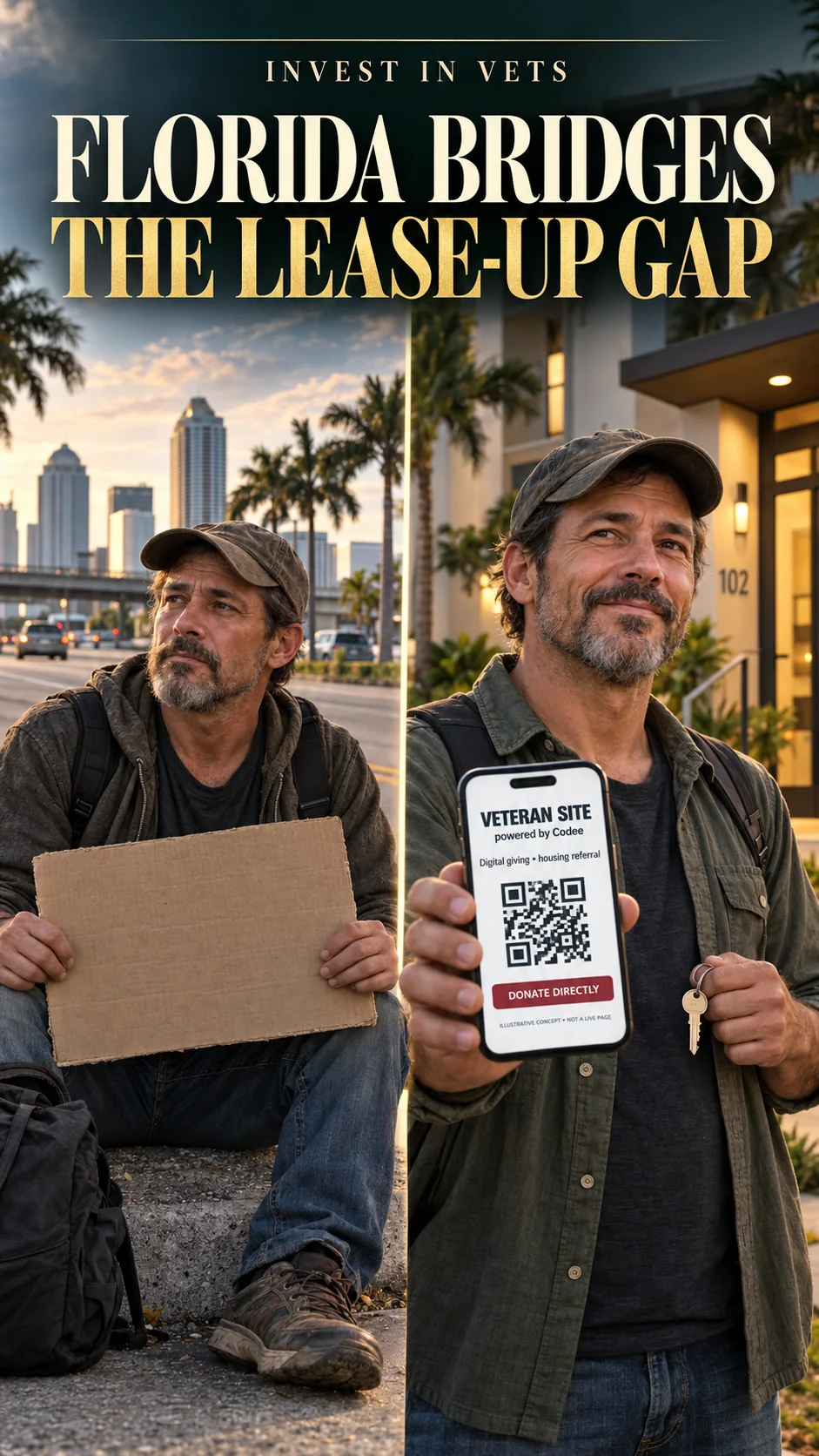
INVEST IN VETS • LOCAL HOUSING CASE STUDY
FLORIDA | VERIFIED POLICY CASE STUDY | OCTOBER 19, 2026
Florida Bridges the Lease-Up Gap
A four-county landlord-incentive pilot targets the delay between an available unit and a HUD-VASH move-in - without pretending a new law has already produced new homes.
Cover disclosure: The Veteran is fictional/composite. The phone page and QR are illustrative concepts, not a live recipient page. No donation result is represented.
Verified program snapshot
LEGAL STATUS | Chapter 2026-125; approved June 11, 2026 and effective July 1, 2026 |
COUNTIES | Broward, Escambia, Hillsborough and Santa Rosa |
HOUSING CREATED | No apartment count is created or promised by the statute |
VACANCY RELIEF | Proportional rent for up to 45 days, or until move-in if sooner |
RISK MITIGATION | Up to $2,000 beyond the deposit for qualifying verified property loss |
IMPLEMENTATION | Subject to annual appropriation, rulemaking, contracts and first-come, first-served funding |
The bottleneck is often the calendar, not the voucher
Florida has created a targeted response to a familiar HUD-VASH problem: a landlord has a unit now, while inspections, documents and move-in coordination still take time. Chapter 2026-125 established the Homes for Veterans Property Management Incentive Pilot Program in Broward, Escambia, Hillsborough and Santa Rosa Counties. The law took effect July 1, 2026 and places administration with the Florida Housing Finance Corporation in consultation with local public housing authorities and VA case managers.
The central tool is vacancy relief. When an eligible landlord enters a rental agreement with an eligible Veteran participating in HUD-VASH, the landlord may seek proportional rent for up to 45 days after the unit becomes available, or until the actual move-in date if sooner. The practical purpose is to keep the unit from being rented to someone else while the Veteran, housing authority and VA complete the last steps. The landlord must submit required documentation within 60 days after move-in, and the Veteran's case manager is directed to help facilitate the request and compliance.
The second tool is limited risk mitigation. If the Veteran later moves out under the conditions written into the law, a participating landlord may apply for up to $2,000 in verified property loss beyond the deposit. That claim requires documentation, including a move-out checklist and current photos, and is available only to a landlord who previously used the vacancy-relief provision. The law does not erase ordinary landlord duties, permit unsupported claims or shift all rental risk to the Veteran.
Enacted is not the same as operating
The status labels matter. This is an enacted state pilot, not a completed housing project and not proof that any Veteran has been housed through it. The statute creates no apartments and announces no Veteran-designated unit total. It says implementation is subject to annual legislative appropriation, requires the corporation to adopt rules and directs it to contract with qualified local administrators. Funding is limited and first-come, first-served; intake can be suspended when appropriations are fully obligated. The statute itself does not state a total appropriation or a current application-opening date.
That distinction also protects landlords from false expectations. A landlord should not reserve a unit based on a social post alone. The safe sequence is to confirm that the Veteran is working with HUD-VASH, confirm the responsible public housing authority and case manager, use the official program administrator's forms, pass the required inspection, document the available date and wait for a written approval path. The 45-day provision is reimbursement authority under the pilot; it is not a private guarantee by Invest in Vets.
HUD-VASH, VA benefits and the local handoff
HUD-VASH combines a HUD Housing Choice Voucher that helps pay rent with VA case management and supportive services. It is not spendable cash, is not the same as VA disability compensation and does not make a home automatically rent-free. The Veteran must qualify, the landlord must accept the voucher, the unit must meet HUD requirements and rent must fit local program rules. VA reported that more than 95,000 formerly homeless Veterans were living in homes through HUD-VASH as of March 2026, but that national measure is not a result count for Florida's new pilot.
In Hillsborough County, VA Tampa identifies local homeless-Veteran care that can connect Veterans to immediate shelter, transitional or permanent housing, treatment, job training and homelessness-prevention support. The statewide September 14, 2026 VA grant announcement also reported $113,274,659 for Florida organizations in fiscal year 2027 through Supportive Services for Veteran Families and Grant and Per Diem activities. Those grants support prevention, rapid rehousing, transitional housing and services; the announcement does not assign that full amount to the four-county landlord pilot.
For Veterans who deployed and hesitate to seek help because of pride, identity or stigma, the first contact should preserve control. Staff can offer a private benefits screening, HUD-VASH referral or conversation without requiring a public story. Disability compensation is a separate earned benefit, and discussing symptoms with an accredited representative or clinician does not obligate a Veteran to share a diagnosis with a landlord, donor or the public.
Privacy and donation safety for a planned Veteran Site
Veteran Site powered by Codee is planned, not represented as live. It is intended to be free for eligible, consenting homeless disabled Veterans. The concept is an opt-in personal donation and referral page with a QR code that leads to that specific verified page. A Veteran could voluntarily link the page to the Veteran's own authorized Cash App, Zelle or other payment account. Codee intends a 0-percent platform commission, which is not a promise of 100 percent net after possible processor charges, taxes or account terms.
A safe page should publish only the minimum information the Veteran approves, avoid diagnoses and identity documents, use a clear consent record, permit rapid pause or removal and show the payment destination before a donor acts. No page should claim donations will guarantee housing. If a Veteran selects a trusted helper, informed consent must name the intermediary and explain that the helper controls funds received until they are transferred; receipts held by that person cannot be represented as guaranteed to reach the Veteran. Housing help, HUD-VASH referrals and the hotline must remain available even when a Veteran declines a public page or donation link.
Five verified AI developments - and five limited nonprofit uses
Each company item below is a dated primary-source development. Each Invest in Vets use is a planning idea only, not a deployed feature. AI must not decide housing eligibility, voucher approval, disability status, donor trustworthiness or whether a Veteran deserves assistance.
1. Amazon Web Services - community AI training, September 29, 2026
Verified development: AWS described free, instructor-led AI and cloud classes delivered with The Seattle Public Library, including more than 50 classes and over 550 learners since 2025. Planned use: partner with a Florida library for small, in-person digital-safety sessions for Veterans and landlords before asking either group to use a QR or online intake tool.
2. NVIDIA - Open Agent Safety Platform, September 28, 2026
Verified development: NVIDIA announced OpenShell and a reference design intended to enforce boundaries, trace agent actions and support governance. Planned use: translate the principle into a lightweight nonprofit control sheet - permitted data, permitted actions, human approval points and an audit log - before any automated tool touches a referral or donation workflow.
3. IBM - K-12 AI leaders fellowship, September 2, 2026
Verified development: IBM launched a fellowship focused on responsible AI adoption and practical training. Planned use: copy the cohort model for staff and volunteers, requiring scenario-based training on privacy, hallucinated eligibility, vulnerable-adult consent and escalation to a human supervisor.
4. Google - Jigsaw Sensemaking partner program, September 22, 2026
Verified development: Google.org said localities could use Jigsaw's Sensemaking AI for large-scale civic conversations at no operational cost. Planned use: analyze anonymized feedback from landlords and Veterans to identify recurring inspection or lease-up barriers; never use it to score individual applicants or infer health conditions.
5. OpenAI - Daybreak for Frontline Defenders, September 3, 2026
Verified development: OpenAI announced subsidized cyber-defense access, training and support for resource-constrained organizations, including nonprofits. Planned use: if eligible, use authorized defensive tools to review the public Veteran Site for vulnerable code and misconfiguration; keep payment credentials out of prompts and require a qualified human to validate findings and fixes.
The practical nonprofit takeaway: build a lease-up bridge desk
Invest in Vets can adapt the Florida model without pretending to administer state funds. A small lease-up bridge desk would maintain a private, role-limited tracker for each offered unit: available date, landlord consent, Veteran referral, Request for Tenancy Approval, inspection date, correction deadline, lease signature, move-in and 30/90/180-day retention. The public dashboard should show only aggregate counts, such as units offered, inspections passed and completed move-ins, with no names, diagnoses, addresses or donation totals.
The desk should give landlords one accountable contact and a written readiness packet covering inspection standards, document deadlines, whom to call and which expenses are or are not eligible under the state pilot. For Veterans, the same team should keep benefits counseling, SSVF prevention, HUD-VASH case management and privacy choices separate from public fundraising. The mission outcome is a stable, affordable lease with support - not a QR scan, an announced appropriation or a promise of free housing.
Need housing help now? Call the VA National Call Center for Homeless Veterans at 877-424-3838 (free, confidential and available 24/7), or use the Tampa and HUD-VASH resources below. To support Invest in Vets' mission, use the official donation page. Donations support the cause but do not guarantee a home, rent payment or individual result; this article makes no tax-deductibility claim.
Veteran and landlord resources
VA National Call Center for Homeless Veterans - 877-424-3838; free, confidential and available 24/7
VA HUD-VASH overview - voucher, case management, eligibility and landlord basics; accessed October 19, 2026
VA landlord guide - five-step HUD-VASH landlord process and inspection information; accessed October 19, 2026
VA Tampa homeless Veteran care - local housing and support access; updated May 20, 2025
Sources and verification notes
Florida Laws, Chapter 2026-125 - approved June 11, 2026; effective July 1, 2026; controlling pilot-program text
Florida Statutes section 83.684 - current codified pilot requirements; accessed October 19, 2026
Florida Senate bill summary for CS/CS/SB 1602 - legislative summary of vacancy relief and risk mitigation
VA Florida homelessness grants - September 14, 2026; statewide FY2027 context, not a pilot appropriation
Amazon Web Services and Seattle Public Library training - September 29, 2026
NVIDIA Open Agent Safety Platform - September 28, 2026
IBM K-12 AI leaders fellowship - September 2, 2026
Google.org and Jigsaw Sensemaking AI - September 22, 2026
OpenAI Daybreak for Frontline Defenders - September 3, 2026