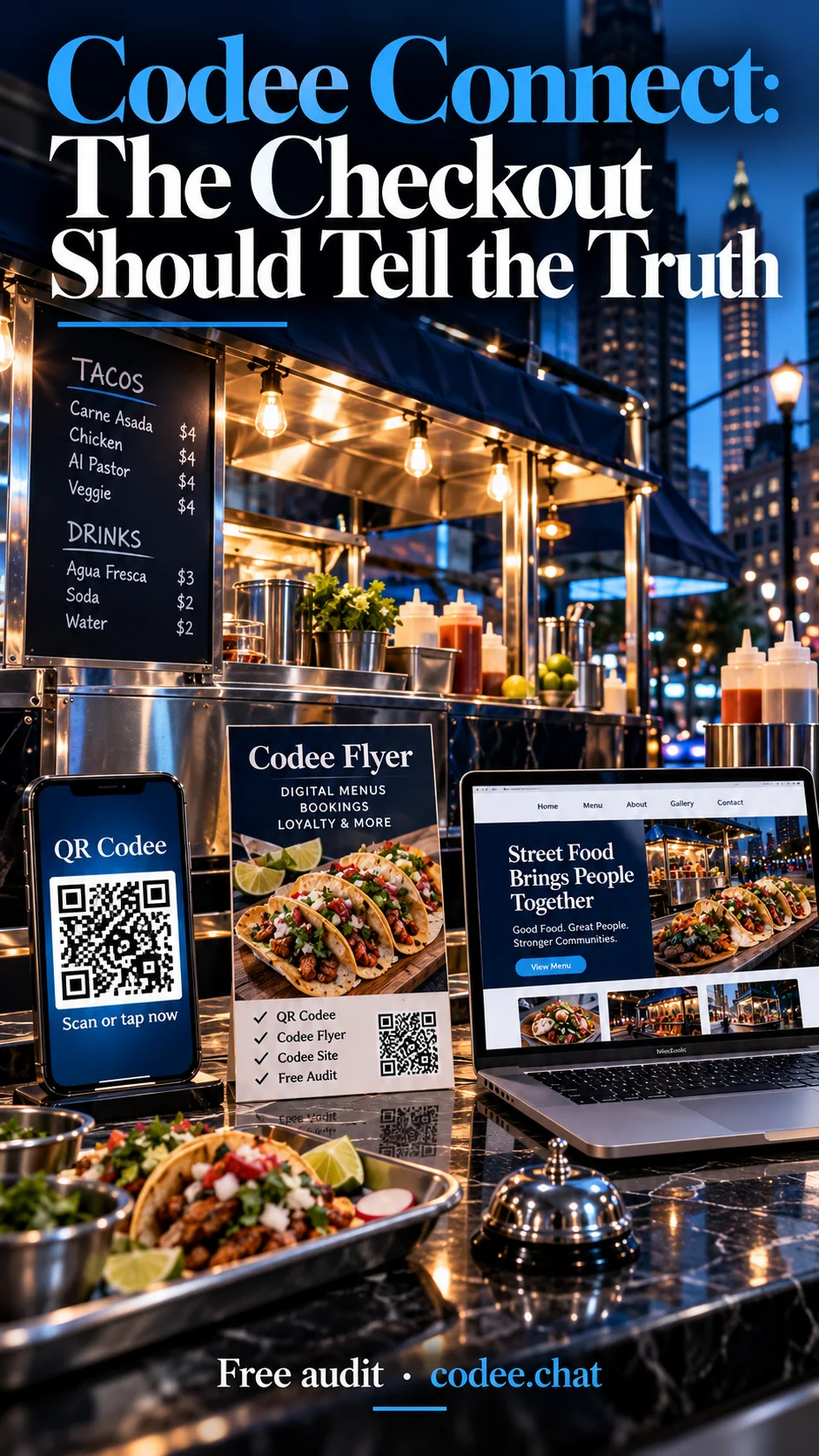
Codee Connect: The Checkout Should Tell the Truth
October 19, 2026 | Founder editorial | Food-cart edition
Cover: https://drive.google.com/file/d/1JhRX2gc_UIfrqPDct9kYAfdBo9-SZ4tv/view
Cover QR artwork is illustrative only; neither the phone QR nor the flyer's corner QR has been decoded and destination-tested.
The moment before someone pays
I believe a business should be allowed to earn a healthy profit. I also believe the customer deserves to understand what they are agreeing to before the final tap. Those beliefs do not cancel each other out. They create a standard. If a price changes at the last screen, if a tip is framed as compulsory when it is optional, or if a service limitation appears only after payment, the business may collect the money but spend some of its credibility.
I keep thinking about checkout because it is where marketing becomes a promise with consequences. A beautiful storefront can attract attention. A friendly message can begin a relationship. But the receipt records the decision that actually happened. My editorial position is simple: the closer a customer gets to paying, the clearer the business should become—not more mysterious.
Pressure is real on both sides of the counter
The U.S. Bureau of Labor Statistics reported on October 14, 2026 that the Consumer Price Index increased 0.6% in September and 3.7% over the prior twelve months. Food away from home increased 0.2% in September, while gasoline increased 9.1% that month. These are national measures, not a claim about any individual food cart's costs. They help explain why an owner might be worried about supplies, fuel, and margins while a customer is carefully checking the total.
Economic source: https://www.bls.gov/news.release/archives/cpi_10142026.htm
A hypothetical food-cart owner might list a taco for $4 and then realize that packaging, card processing, permits, and spoilage make the margin too thin. I do not think that owner must absorb every cost. A sustainable price can include real overhead. The moral question is how the price is presented. Would the owner rather publish a realistic total and explain it, or display a tempting number that changes at the register? A customer can accept an expensive offer and still feel respected. A cheaper offer can feel dishonest when the terms move.
Clear pricing is not the same as cheap pricing
Some business advice treats transparency as a marketing slogan. I want to treat it as operational discipline. A price list should say what is included. An estimate should identify what could change and why. Optional add-ons should look optional. A refund or cancellation policy should be readable before the buyer commits. If the service depends on a separate provider or payment processor, that fact belongs in the explanation.
There is a fair counterargument: too much information at checkout can overwhelm people. A small shop cannot place an entire contract beside every button, and a long warning can create as much confusion as a hidden fee. I agree. The answer is not endless fine print. It is progressive clarity: a concise price and service description first, a visible link to the full terms, and a clear confirmation before payment. Good design makes the essential facts easier to see.
Five AI-company developments worth separating from the hype
These are five dated first-party announcements, not claims that Codee uses these systems or that any one model guarantees business success. Each illustrates a choice available to entrepreneurs who evaluate tools carefully.
1. OpenAI — August 7, 2025: OpenAI introduced GPT-5, describing improvements in coding, writing, reasoning, and business tasks at launch. A new entrepreneur could use a capable assistant to draft a plain-language service description; an established firm could review a checkout FAQ. Both still need a person to verify prices, legal terms, and factual claims. This was a model launch, not a promise that AI can authorize charges.
Source: https://openai.com/gpt-5/
2. Anthropic — September 29, 2025: Anthropic released Claude Sonnet 4.5 and described upgrades including checkpoints in Claude Code and a Claude Agent SDK. A startup might prototype a simple price estimator; an existing company might test a workflow for reviewing customer-facing copy. The company's performance descriptions are its own claims, and any agent handling payments would require separate security, approval, and testing.
Source: https://www.anthropic.com/news/claude-sonnet-4-5
3. Google — June 17, 2025: Google announced Gemini 2.5 Pro and Flash as generally available and introduced Flash-Lite in preview. For a new business, the distinction between stable and preview software matters when choosing a tool for an essential task. An established enterprise may compare cost, latency, and accuracy before using a model in support operations. A preview is not a production guarantee.
Source: https://blog.google/products-and-platforms/products/gemini/gemini-2-5-model-family-expands/
4. Meta — April 5, 2025: Meta shared Llama 4 Scout and Maverick as open-weight multimodal models and previewed Behemoth rather than releasing it. An early-stage builder could evaluate deployment and licensing tradeoffs; an established company could assess privacy and infrastructure needs. Open weights do not mean zero operating cost, and a previewed model should not be described as generally available.
Source: https://ai.meta.com/blog/llama-4-multimodal-intelligence/
5. Adobe — April 24, 2025: Adobe announced Firefly Image Model 4 and 4 Ultra and made Firefly Video Model generally available, while Firefly Boards was in public beta. A new shop could explore mockups before buying printed materials; an established brand could test variations for campaigns. Adobe's descriptions of commercial suitability are vendor claims; actual rights, accuracy, and print readiness still need checking.
Source: https://news.adobe.com/news/2025/04/adobe-revolutionizes-ai-assisted-creativity-firefly
Tools should clarify the offer, not obscure it
The connection between these announcements and checkout is not that artificial intelligence makes an ethical company. It does not. A model may generate a polished explanation of an unfair charge just as easily as it drafts a useful one. Human responsibility begins where the tool stops: setting prices, obtaining consent, honoring refunds, and correcting mistakes. For both a first-time founder and an established enterprise, the most valuable automation might be a reminder to review the final customer experience.
That is also how I want to describe Codee's three main digital products without claiming features that have not been verified. QR Codee is a phone-friendly single large QR presentation with a short headline and the instruction “Scan or tap now.” A printed Codee Flyer can introduce an offer with a small corner QR pointing to that flyer's own page only after the destination is created and tested. A Codee Site is an elegant three-to-five-page business shell displayed here on a MacBook, with content and actions tailored to the actual client. A free audit is an invitation to discuss the fit, not a guarantee of sales or functionality.
The food-cart scene on today's cover is a visual example, not a real customer deployment. Its QR patterns are decorative, not verified live destinations. I would rather disclose that clearly than allow an attractive image to imply a working checkout or an actual client site.
A practical five-minute checkout test
Here is the lesson I would give a small-business owner: take the same path a first-time customer takes. Write down the advertised price, the amount at the final confirmation, and every choice made between them. Ask whether taxes, tips, delivery, deposits, and optional services are clearly distinguished. Read the policy as someone who has never met you. If the total surprises you, rewrite the screen before trying to increase traffic.
Then repeat the test on a phone. A transparent policy hidden behind tiny text is not practically transparent. Ask someone outside the business to explain what they would receive, when, and at what cost. Their confusion is useful information. The goal is not a checkout that wins every sale. It is a checkout that earns the right to be trusted again.
The mission: a free Veteran Site powered by Codee
My larger reason for building digital tools includes a planned free, opt-in Veteran Site powered by Codee for eligible homeless disabled veterans. The concept is a personal digital page that, with the veteran's informed permission, could share an approved story and link to the veteran's own authorized payment method for voluntary direct support. Codee aims to retain 0% of those gifts, but third-party payment processing fees or other deductions can apply. That is not a promise that the veteran receives a net 100%, nor a promise of donations, housing, or a particular outcome.
Consent, privacy, identity checks, and control over what is public must come before promotion. A veteran should not have to disclose sensitive details to participate. The page is not a substitute for VA services, housing case management, or HUD-VASH eligibility and referral processes. The practical mission is to connect responsible digital support with existing veteran-assistance pathways, not to replace them. Learn about the nonprofit mission at https://investinvets.online/ and request a free Codee audit at https://codee.chat/. I want the final payment screen—and the mission behind it—to tell the truth.
---