Codee Connect: The Margin Must Be Earned
COVER: https://drive.google.com/file/d/1a4mdbw4gwJmPHkldB1W1JvVe832ys2Dt/view
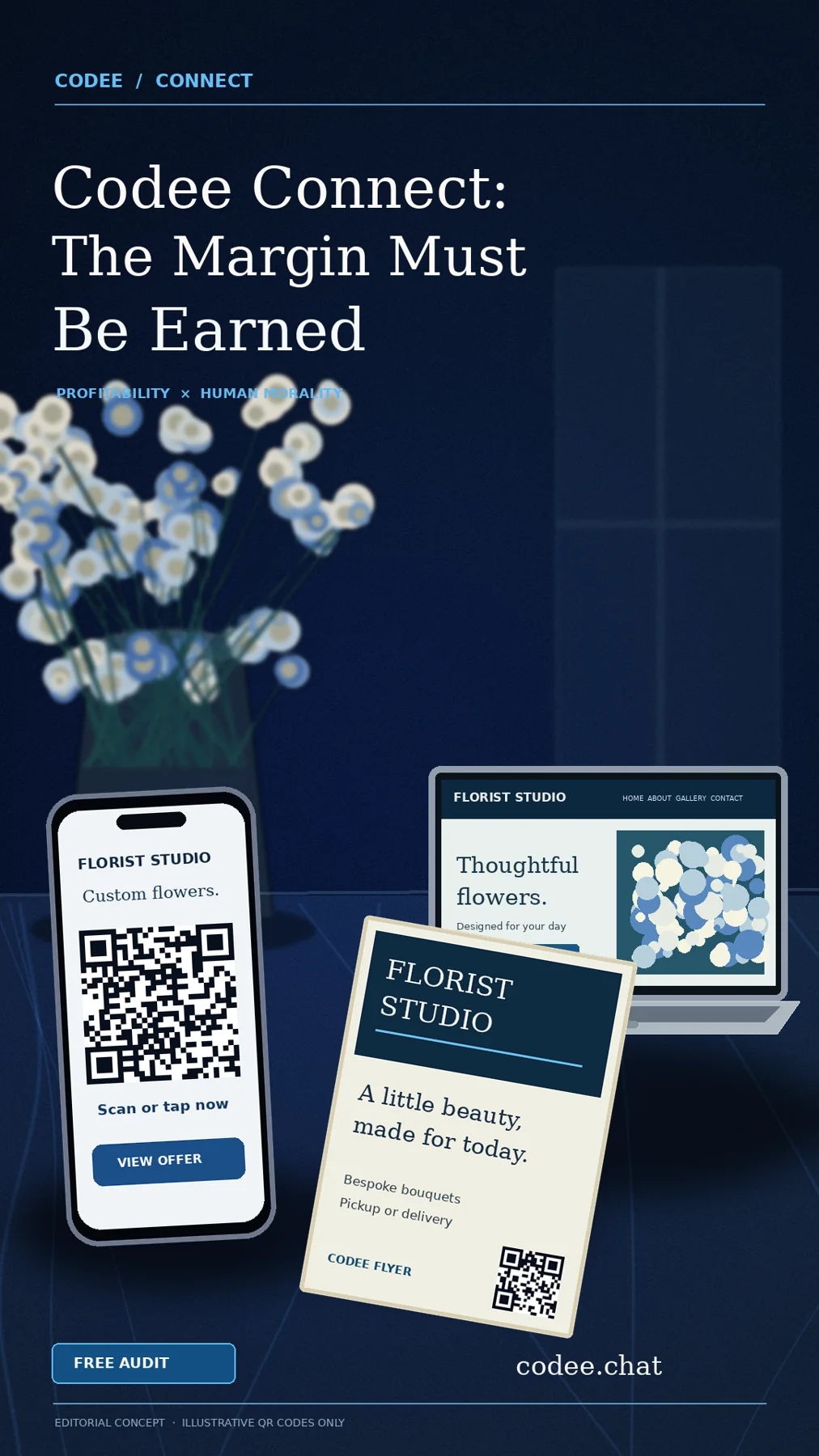
Visual: original 1080×1920 rendered composite (not photorealistic photography); both QR patterns illustrative, not scan-tested.
October 21, 2026
Founder editorial | October 21, 2026 | Florist-shop edition
Profit Is Necessary. Permission Is Not Optional.
I want a business to earn enough to stay open, pay its bills, improve its work, and compensate people fairly. Profit is not an apology. It is what lets a useful service survive beyond its first burst of enthusiasm. But a healthy margin has to be earned through a clear offer, not extracted through confusion, artificial urgency, or an interface that makes the customer feel foolish for asking a question.
Consider a florist preparing for a busy holiday. This is an editorial scenario, not a real Codee customer or a claim about a transaction I witnessed. The shop might need to charge more for rare flowers, skilled arrangements, and same-day delivery. Those costs are real. The moral problem begins if the delivery fee is hidden until the final click, the advertised bouquet bears little resemblance to the delivered one, or a countdown suggests a shortage that does not exist. The difference between fair pricing and manipulation is not whether the owner makes money. It is whether the buyer can make an informed choice.
The Economy Makes Honest Pricing Harder—and More Important
The Bureau of Labor Statistics reported only 29,000 additional U.S. nonfarm payroll jobs in September 2026, with unemployment at 4.2%. Those figures do not describe every local market or establish why one florist's sales rise or fall. They do show why I would avoid treating every hesitant customer as someone who simply needs more pressure. The Federal Reserve's May 2026 household report found that 63% of adults said they could cover a hypothetical $400 emergency expense entirely with cash or its equivalent. That leaves a substantial share without that cushion. Customers may be balancing necessities while an owner is balancing payroll, rent, and inventory.
I do not think this means a business must discount everything. A shop that sells below cost to appear kind may close, leaving workers and customers worse off. I think the stronger answer is to explain the price, offer an honest lower-cost option when possible, and state the trade-offs. A smaller arrangement at a transparent price can be more respectful than a premium package that only looks affordable before checkout.
Five AI Developments—and the Human Decision Behind Each
These are five dated announcements from the companies themselves. They are not Codee features, customer case studies, or proof that any particular business will earn more money.
1. Google — October 20, 2026. Google announced new Gemini tools for small-business owners, including a dedicated business hub, brand-style inputs, connected apps, and financial visualizations, with some features rolling out. A new florist could draft promotional concepts; an established shop could organize existing information. I would still verify numbers, permissions, and image rights before publishing.
2. Anthropic — October 7, 2026. Anthropic introduced Claude Haiku 5.5 as a small model designed for fast, high-volume, cost-sensitive tasks, accompanied by company performance and pricing claims. A startup might test low-risk FAQ drafting; a larger operation might evaluate inquiry classification. Neither should let an unreviewed model invent delivery guarantees or make sensitive decisions.
3. Microsoft — September 25, 2026. Microsoft announced a redesigned Copilot with Home, Code, and Autopilot. Its announcement distinguished current functions from Frontier rollouts and private previews; not every subscriber immediately gets every feature. New businesses can study workflow ideas. Established teams need governance, permissions, and cost controls before delegating work.
4. Adobe — June 18, 2026. Adobe announced additional Firefly AI Assistant beta skills, including brand-kit and short-video creation, while separately previewing an upgraded creative studio in private beta. A founder might test consistent product imagery; an existing brand might explore repeatable campaign assets. Preview status matters, and final visuals still need human approval.
5. OpenAI — April 22, 2026. OpenAI introduced workspace agents for teams, describing shared workflows, connected tools, permissions, and approval controls. The original announcement discussed research-preview access; current availability should be checked separately. A startup can learn the value of a documented process; an established enterprise can evaluate governed delegation. The useful lesson is accountability, not automation at any cost.
What a Moral Margin Looks Like on a Real Offer
My practical test is simple: could I explain the same price, limitation, and refund rule aloud to a customer standing across the counter? If the answer is no, the sales page needs another draft. I would separate the base service, delivery or rush fees, optional extras, payment timing, and the real path to a person. I would also put the most important limitation near the action button, not in a hidden footer. That makes comparison easier and may reduce disputes even when it costs a few impulse purchases.
There is a reasonable counterargument. Every extra explanation adds friction; too much disclosure can overwhelm people, and a small owner does not have a compliance department. I agree that a wall of fine print is not the answer. The goal is concise clarity: one honest headline, one actual price or quote rule, one plain limitation, and one reachable next step. Good design reduces work for both sides.
A Practical Florist Exercise: One Offer, Three Surfaces
Imagine a florist selling a custom arrangement with pickup or delivery. This is a teaching example, not an existing customer build. First, put QR Codee on a phone with ONE large code, a short service headline, and the words “Scan or tap now.” The QR should only be called functional after its destination has been decoded and tested. Second, place a beautiful printed Codee Flyer on the counter with a small corner QR leading specifically to that flyer's page—but only after the page and destination have been verified. Third, show an elegant Codee Site 3–5-page shell on a MacBook, with clear service details, gallery, about, and contact or booking paths appropriate to the actual agreement. A free audit is the first conversation, not a promise of an automated review or instant results.
Those are three different customer surfaces, not three excuses to hide the price. I would compare them using one simple worksheet: offer understood, next action clear, destination tested, and owner approval recorded. Then I would ask a person unfamiliar with the business to explain what happens after tapping. If they cannot, I would simplify before buying more advertising.
My Challenge to Business Owners
Write down one place where your customer may be guessing: what is included, how long it takes, who receives the payment, whether a deposit is refundable, or how to reach someone. Correct that one point today. A young business can build trust before it has a reputation. An established business can recover trust by making a confusing process easier to understand. Neither needs to choose between earning a living and respecting the people who make that living possible.
To explore the Codee business tools and request a conversation about a free audit, visit codee.chat. Verify the actual intake and current offer before making a purchase or publication claim.
The Veteran Site Mission: Dignity Before a Donation Button
The larger purpose matters to me. Codee's Veteran Site is a planned free, opt-in personal digital page for eligible homeless disabled veterans, subject to individual verification and consent. It could share a veteran-approved story and, where authorized, provide a direct way for supporters to offer voluntary help. Privacy, informed consent, and the ability to decline participation must come first.
With the veteran's informed consent, a page could link to the veteran's own authorized payment method for voluntary direct support. Codee aims to retain 0% of such gifts, although third-party payment processors and other services may deduct fees; nobody should promise a net 100% received. No photograph, location, medical detail, or payment handle should be displayed without permission, and the veteran must be able to request changes. There is no guarantee of donations, housing, or other outcomes.
Direct support is not a substitute for established assistance. Veterans experiencing homelessness or housing risk should also explore VA homeless services and HUD-VASH, which combines qualifying housing vouchers with VA case management and supportive services. VA offers a National Call Center for Homeless Veterans, available around the clock. Learn about the nonprofit mission at investinvets.online and the business tools at codee.chat. The mission should be measured by dignity, consent, and real help—not a persuasive button.
First-party and economic source links
BLS September 2026 employment report: https://www.bls.gov/news.release/empsit.nr0.htm
Federal Reserve May 2026 household report: https://www.federalreserve.gov/publications/2026-economic-well-being-of-us-households-in-2025-savings-investments.htm
VA HUD-VASH program: https://department.va.gov/homeless/hud-vash/
Google, October 20, 2026: https://blog.google/innovation-and-ai/products/gemini-app/new-tools-small-business-owners/
Anthropic, October 7, 2026: https://www.anthropic.com/claude-haiku-5-5
Microsoft, September 25, 2026: https://blogs.microsoft.com/blog/2026/09/25/introducing-the-new-copilot-with-home-code-and-autopilot/
Adobe, June 18, 2026: https://blog.adobe.com/en/publish/2026/06/18/adobe-firefly-introduces-new-agentic-capabilities-and-an-upgraded-creative-ai-studio-built-for-the-way-you-work
OpenAI, April 22, 2026: https://openai.com/index/introducing-workspace-agents-in-chatgpt/
Business tools: https://codee.chat/
Nonprofit mission (public response not independently verified): https://investinvets.online/