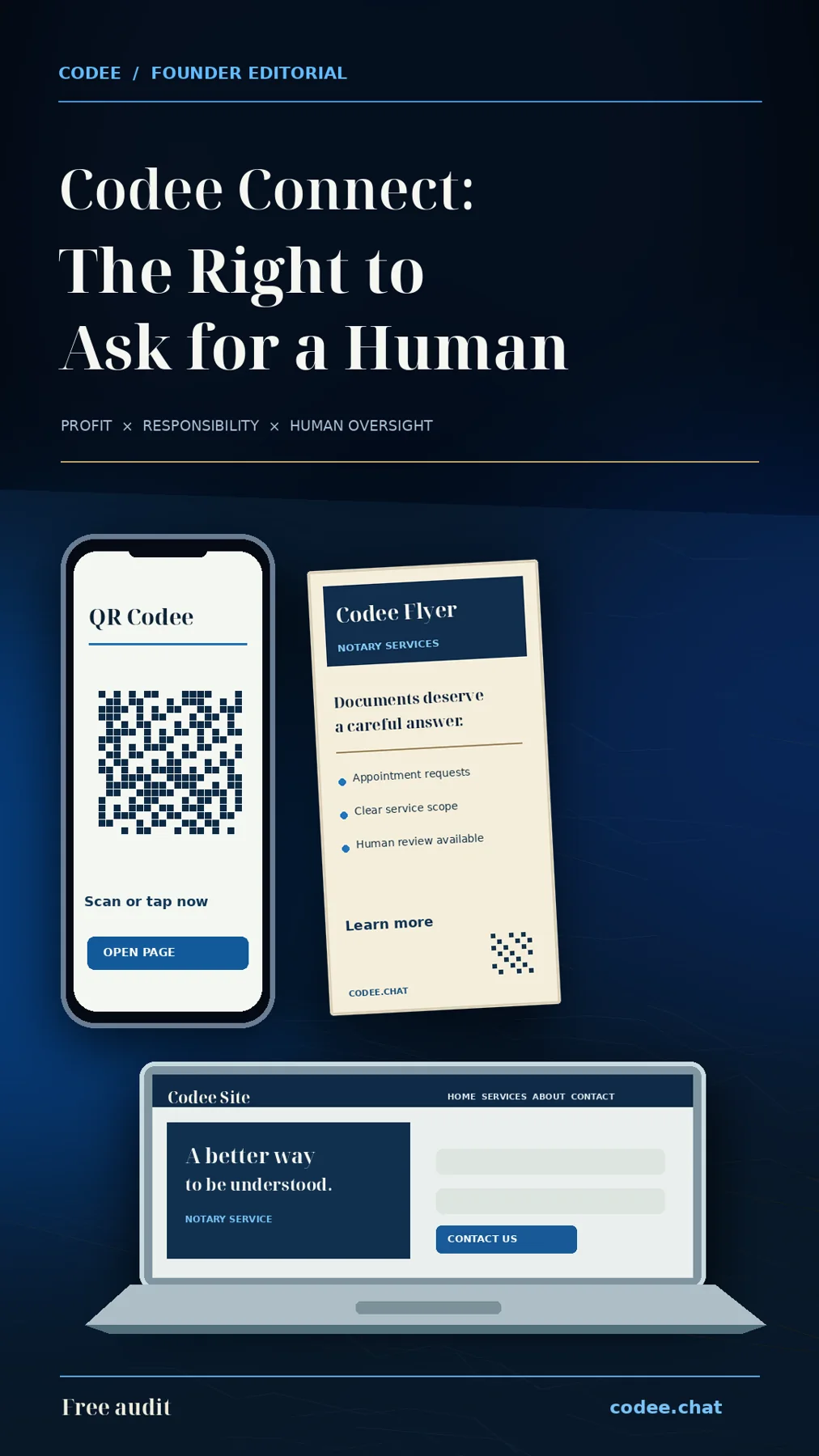
Codee Connect: The Right to Ask for a Human
October 20, 2026 | Founder editorial | Notary-office edition | Codee Connect
COVER: https://drive.google.com/file/d/1UdJ7VYbw8eNm9_tasXWLJXQ_lz5aEDpE/view — Original 1080×1920 editorial device mockup visually inspected and saved separately in this folder. The QR marks are decorative and NOT functional. Image is a rendered composite, not photorealistic studio photography.
The question behind the polished answer
I want a business to make money. I also want the person buying its service to retain the right to ask a real person what is happening. That becomes more important—not less—when software gets faster. A beautifully written reply can explain a service, but it cannot personally accept responsibility for a disputed fee, an identity-sensitive document, or a promise that was never authorized.
Picture a notary office, an editorial example rather than a real Codee customer. A visitor scans a promotional card, opens a simple site, and asks whether a particular document needs witnesses. An automated response might sound certain. Yet notarial requirements depend on the jurisdiction, document and circumstances. The correct next step is often to identify the question, explain the service's limits and direct the visitor to the authorized notary or relevant professional. Speed is valuable. A fabricated assurance is not.
Profit must include the cost of being reachable
The September 2026 U.S. Consumer Price Index rose 3.7% over 12 months, the Bureau of Labor Statistics reported on October 14. That is not an inflation rate for every local business; it is broad context for why owners face cost pressure and customers inspect prices closely. The Federal Reserve's May 2026 household report found 73% of adults said they were doing okay or living comfortably financially in 2025, while price increases remained the most common financial concern. A founder who ignores those pressures may underprice the work; a founder who uses them to justify opaque fees may lose trust.
I think profitability should be calculated after honest labor, reliable delivery, customer support and correction costs—not just after the cost of generating a page or message. If a business saves ten minutes on an inquiry but forces the customer to spend an hour finding someone who can correct a mistake, the saved labor has been pushed onto another person. That transfer may look efficient in a dashboard and still be a poor bargain for the community.
The best automated answer knows when to stop
Automation is useful when it handles bounded, repeatable work: hours, service descriptions, appointment-request instructions, a checklist of documents to bring, or a clearly labeled draft. It is less suitable for declaring legal conclusions, improvising prices, approving exceptions or claiming that a payment cleared without verification. I would rather see a short answer that says, 'This needs a human review,' than a persuasive answer that crosses a line nobody agreed to cross.
For an established enterprise, the problem expands. One uncertain answer can be copied across dozens of locations and thousands of messages. A young enterprise may be tempted to let automation act as the entire front desk because hiring is expensive. I understand that argument. But scale magnifies the value of a clear escalation route. The ethical question is not whether software should answer anything; it is who owns the exceptions, and how quickly a customer can reach that owner.
Five dated AI-company developments worth reading
1. OpenAI — October 7, 2026: ChatGPT Business release notes describe GPT-6 and Intelligent UI rolling out to eligible Business workspaces. This is a vendor-reported rollout, not a claim that every business has access. For a startup, richer interfaces may make it easier to compare draft offers; an established team still needs approval and access rules before using outputs in customer-facing decisions. Source: https://help.openai.com/en/articles/11391654-chatgpt-business-release-notes
2. Google — October 13, 2026: Google announced Gemini 4 Argon availability for developers and enterprises via its API and other eligible surfaces. Google describes complex reasoning uses in finance, coding and legal workflows; those are company claims, not a substitute for qualified review. A startup can test document organization; a larger firm should benchmark reliability and costs against its own tasks. Source: https://blog.google/innovation-and-ai/models-and-research/gemini-models/introducing-gemini-4-argon/
3. Anthropic — October 7, 2026: Anthropic launched Claude Haiku 5.5 and positioned it for high-volume, cost-sensitive work such as classification and support. Its cost and performance statements are vendor claims. A new shop might evaluate narrow FAQ drafts; an established service team should measure incorrect escalation and customer outcomes, not only latency. Source: https://www.anthropic.com/claude-haiku-5-5
4. Microsoft — May 28, 2026: Microsoft announced new Microsoft 365 Business Standard and Premium offerings with Copilot built in, with July 1 availability described in its announcement. This is a product announcement, not a guarantee that a given organization's setup or connector is enabled. A startup should ask whether the bundle replaces a tool; an established firm should review permissions before connecting records. Source: https://www.microsoft.com/en-us/copilot/blog/2026/05/28/introducing-microsoft-365-business-with-copilot-the-new-standard-for-small-business/
5. Amazon Web Services — October 19, 2026: AWS announced structured-output support for Anthropic Claude models on Amazon Bedrock. It says schema-conforming JSON can reduce custom parsing. That is an actual platform capability announcement, not proof that a business's whole workflow is accurate. Startups can test consistent intake fields; established operators should still validate the values, consent and downstream actions. Source: https://aws.amazon.com/blogs/machine-learning/structured-outputs-for-anthropic-claude-models-on-amazon-bedrock/
The counterargument deserves respect
Some owners will reasonably say a customer does not need a human for every basic question. They are right. Requiring a person to answer every request can raise prices, slow access, and burn out a tiny team. Others worry that making escalation too prominent invites abuse or creates unrealistic expectations of 24-hour support. Those are operational concerns, not moral failures. My answer is to publish response windows and boundaries, make ordinary self-service excellent, and offer a human route for sensitive, disputed or exceptional matters. Access does not have to mean instant access.
Three Codee products, one honest customer journey
The QR Codee concept begins on a phone with one large QR and a concise headline: 'Scan or tap now.' It should direct people to one clearly described destination only after the actual code is generated, decoded and tested. The Codee Flyer is a distinct printed promotional piece, with its own small corner QR intended for that flyer's page; no destination or working QR is claimed here until verified. The Codee Site is an elegant 3–5-page business-site shell shown on a MacBook, with room for Home, Services, About and Contact, subject to the real project's agreed scope. These are product presentations, not proof of an installed booking engine or automatic payments.
A free audit is the fourth invitation, not a hidden upsell. I want a prospect to be able to ask what the offer is, what is already working, what still requires manual setup, and what happens after payment. Visit https://codee.chat/ to explore Codee and ask about an audit; I have not independently confirmed a dedicated free-audit intake on that landing page. A professional business earns the next step by describing the present step accurately.
A practical lesson: write the escalation rule before the prompt
For the hypothetical notary office, I would begin with four columns on one page: question type, approved answer, human owner, and maximum response window. 'Where are you located?' can use a verified public answer. 'What does this appointment cost?' should use a current approved price. 'Will this document be accepted?' should go to a qualified person, not an invented guarantee. 'I was charged twice' should go to a human with access to actual payment records. Then I would test five ordinary questions and five difficult ones before publishing the flow. The practical metric is not simply response speed; it is whether the person reaches a truthful next step.
The mission: a Veteran Site powered by Codee
My larger reason for caring about honest digital systems is the planned Veteran Site powered by Codee: a free, opt-in personal digital page for eligible homeless disabled veterans, subject to verification and consent. The intended page could let a veteran share an approved story and link directly to that veteran's own authorized payment method for voluntary support. Codee aims to retain 0% of those gifts; third-party processor fees, deductions or other charges may apply, so nobody should promise that 100% of a contribution arrives net. Participation must protect privacy, respect consent and avoid implying guaranteed housing, donations or success.
A digital page is not a replacement for housing assistance. Veterans experiencing homelessness or at risk should also explore VA homeless programs and HUD-VASH pathways, including the National Call Center for Homeless Veterans at 877-424-3838. Learn about the nonprofit's mission at https://investinvets.online/ (reachability not independently confirmed today), and Codee at https://codee.chat/. Profit can fund responsible work, but only if we keep the human being at the center of the promise.
Sources and editorial verification
Economic context — U.S. BLS, September 2026 CPI, released October 14: https://www.bls.gov/news.release/archives/cpi_10142026.htm
Household context — Federal Reserve, 2025 SHED, published May 19, 2026: https://www.federalreserve.gov/publications/2026-economic-well-being-of-us-households-in-2025-executive-summary.htm
VA/HUD-VASH information: https://department.va.gov/homeless/hud-vash/
Vendor developments above are exactly five dated first-party company announcements/notes; vendor performance claims are not independently verified. The notary office is a hypothetical editorial example. Research checked October 20, 2026 (America/New_York).